Two Women Changing the Dementia Narrative
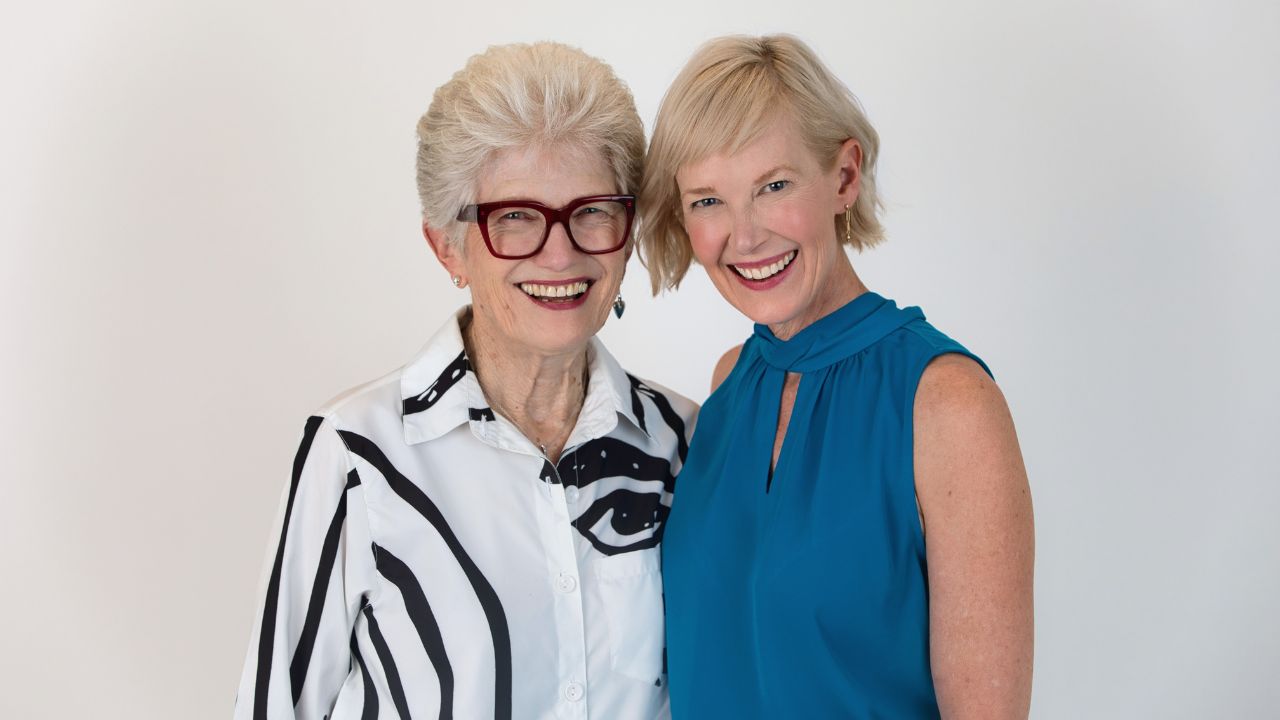
Nancy Nelson and Kat Hartley discuss early diagnosis, stigma, resilience, and why purpose, support, and social connection matter for living well with dementia.
Journey to Diagnosis is a Being Patient series sponsored by Eisai. As with all of our reporting, the sponsor has no role in choosing guests, shaping questions, or reviewing content before publication.
Nancy Nelson was diagnosed with early-onset Alzheimer’s in 2013 after noticing cognitive changes in her daily life, including missed appointments and a moment when she could not recognize a familiar house. In the years since, she has turned that diagnosis into advocacy, publishing poetry, joining research, and leading early-stage support groups for others living with dementia.
Nelson joined forces with Kat Hartley, a pharmacist and brain health professional whose personal life and career have been shaped by Alzheimer’s across generations of her family. Together, they co-founded dangle & dot, a social enterprise aimed at challenging stigma and broadening the public understanding of what life with dementia can look like.
In this conversation with Being Patient’s founder, Deborah Kan, Nelson reflects on the power of early diagnosis and the value of staying socially engaged after a diagnosis. Hartley offers the perspective of a care partner and advocate working to replace the usual tragedy narrative with one rooted in dignity, resilience, and connection. The discussion highlights a central message: while dementia brings profound change, a rich and active life can still flourish through purpose, community, and support.
Being Patient: Nancy, tell me how you first got diagnosed.
Nancy Nelson: Well, I was starting to miss appointments. Words were doing whatever they do and not with you when you need them.
My dad passed away in 2002 from Alzheimer’s. And while I never thought I would have it, I was starting to feel some of those symptoms. And so I just thought I wanted to be proactive. And one led to another, and I had a couple of incidents that came up.
The first real incident was that I was bicycle riding with a friend of mine in a neighborhood that I was fairly familiar with. My kids were back in town and were living at that house, and I had been there many times, and we drove up and down and back again, and I couldn’t recognize the house. And I said, “Oh my gosh, what’s wrong?”
Being Patient: Kat, tell me a little bit about your family history with Alzheimer’s disease.
Kat Hartley: Yeah, it’s been a lifetime, actually, starting as a little girl, primarily on my paternal side, losing my grandfather, my grandmother. They had four boys and losing all four of them, one of which was my father. And then a stepmom. And then recently, my mom, she ended her life here at my house on hospice and had some vascular-type dementia. And I’ve cared for a special brother who had a different brain from birth.
But that long journey, every decade, I was hearing the conversations as a little girl, as a teenager, as a young woman trying to have kids, caring across the country, all the scenarios that the families go through. I feel like I’ve had some experience, and it really has shaped what I hope to bring to other caregivers and families.
Being Patient: Can I ask if you know if you have a genetic predisposition, or people in your family did? Did you find out that information?
Hartley: Honestly, I have not officially tested, but I walk around knowing there’s a good likelihood that at least half of my DNA is probably ApoE4 positive. And so brain health and prevention have really become forefront. And in Vegas terms — we live in Las Vegas — doubling down on my own brain health and already educating my children.
Being Patient: Nancy, I was watching a video of you two on your website, and saw that when you went in for your MoCA test, the early cognitive assessments where you’re given a few words and then asked a little while later what those words were. You turned it into a book of poetry, which I thought was such a beautiful thing. Tell me a little bit about that experience. And when did you realize, I’m going to speak out with dementia rather than I’m going to go hide and live with my diagnosis?
Nelson: You know, within 48 hours of getting the first diagnosis — and my dad had passed, so I was familiar with that part of it — but you never think it’s going to happen to you as a daughter. So I just kept living fast and furious, and all of a sudden within these 48 hours, suddenly I was waking up between 3 and 5 a.m. each and every morning. Words were just coming to me. I was writing and writing and writing, and they were words that I wouldn’t necessarily use, right? It was my way of journaling.
I was so curious about it that I finally said something to someone. I said, “Gosh, all these words are coming to me.” And, “Well, let me see them. What do you think?” And one thing led to another, and I published my first book after the first year after being diagnosed. And I have written two since then. And they are poetry in the moment. Some people call them prescription poetry. It is a way for me to tell poignantly from the moment, this is what I’m thinking right now.
Being Patient: Had you ever written a book previous to this? Were you a writer before?
Nelson: Oh, I had played with writing, but no. No, and not poetry. Nothing like poetry. Who’s a poet?
Being Patient: Tell us a little bit about how that word test kind of led to your first poetry book? What were the three words?
Nelson: Blue River Apple.I’m probably going to remember that one for a long time.
Yeah, those were the words that the doctor had given me to remember. And then they take you off and talk about other things. And then they go back to that.
Why did the words come to me? I woke up every day at this time, and it wasn’t because I had thought about it, or I was gonna do this, or I had been diagnosed for a year, and I thought I should write about it. Those words were there.
Being Patient: Kat, you’ve worked in Alzheimer’s and research. You were at Cleveland Clinic before. Tell me how your life kind of took you into this Alzheimer’s world.
Hartley: I was a pharmacist, but I took a big left turn right out of pharmacy school. And I had done an internship at the FDA. And so I went up to Washington, D.C., was part of the neuroscience division there, and was involved with the very first drugs that we had back in the ’90s that were approved or looking to be approved.
At this time, my dad and a lot of family members were having it, and they were looking to me like, well, the government or FDA or somebody, NIH, sure has the answers. But I really saw how far understanding the disease — and even the clinical trials lumped in so many people with different types of dementia — we were so far away. But whatever professionally I could do, I was going to do around Alzheimer’s disease.
And I was fortunate enough to be hired at the Cleveland Clinic Lou Ruvo Center in Las Vegas, where I did work on brain health and educating the public about the things we can do to help prevent or delay.
Being Patient: Tell me about how you two met.
Hartley: We were both out advocating. Nancy was promoting her books and talking about her diagnosis. I was out advocating for our research funds. And people just kept putting us on the same docket to talk. Yeah, and we would bump into each other in parking lots, like, “What do you think?” I thought she was pretty amazing.
Nelson: We just liked one another. We could be bonus mother and daughter to one another, and we are. A lot of people think we are.
Being Patient: Nancy, tell me a little bit about what type of diagnosis you’ve had. Off the bat, did they say that it’s Alzheimer’s? Did you get a PET scan? Have you had a blood test now? Where are you in that diagnostic journey?
Nelson: Well, I think it’s pretty conclusive what it actually is. Originally, we were talking about this earlier, and I said early onset or early stage — I can’t remember in this moment of time what was given to me as the first diagnosis. And right with that was a prescription to fill and to start taking deep, heavy medications and come back in six months.
Being Patient: Was that Aricept by any chance?
Nelson: It was. And my response was, “Thank you, but no thank you.” I don’t know enough to start taking medications. I have not taken any medications. I’m not saying never. I’m just saying not now.
Being Patient: You’ve been diagnosed for more than 10 years. Tell me about the presentation of symptoms today. Do you feel progression?
Nelson: Yeah, it’s been 13 years, and I would say, I don’t feel it was necessarily a misdiagnosis. I think what they knew then is what the diagnosis was. I didn’t ingest that diagnosis. I took it, I learned about it, learned how to advocate for it, and have spent my time in most ways helping other people get through what they hear, see, and do after Alzheimer’s or dementia is brought into their life.
It is because of getting the diagnosis early that I have been able to do so many things to help myself. And I think that’s all we need to know. We shouldn’t just sit here and wait for someone to give us a pill or something and hope that they can fix us. I think we need to become a partner in our own health, and we should get up and get doing. And so I know no difference. And so that’s what I do.
Hartley: But I’d like to fill in, because I know people are so curious about Nancy, because I go out with her and I have people whispering in my ear, “Well, for sure she doesn’t have anything.” And we’re very open and honest because we want to be. So Nancy did get that first diagnosis from a general neurologist.
But then four years later, she entered an observational trial at the Cleveland Clinic, which was a very extensive look into Nancy in terms of imaging, PET scans. So we got amyloid-positive PET scans. And she has been followed for eight years in that journey, so every year we were able to see what was declining or not.
So at that point, she got a mild cognitive impairment diagnosis. That’s where that kind of came in from a more dialed-in view, I would say. But all the hallmarks are there for Nancy in terms of Alzheimer’s disease pathology, even some white matter disease going on. So for me, with even this, this is why she is remarkable — to show that resilience and that continuing on.
“It is because of getting the diagnosis early that I have been able to do so many things to help myself.”
Being Patient: How many years have you both known each other?
Hartley: Since 2016.
Being Patient: Have you noticed changes? They always say someone who spends a lot of time with the person…
Hartley: Yes, some. Yes, we’ll be honest. You’ve had some changes and a little more anxiety over the changes, I would say.
Nelson: Before, in the very first years, the anxiety wasn’t what it is today. So I agree. There are changes.
Hartley: And I just know as a caretaker, and being co-partners in this business, that I know one of my roles is to keep her secure, keep her believing in herself.
Being Patient: I believe that social engagement is so much of living well with this diagnosis. I think if you feel like you have purpose, I think that makes a huge difference.
Nelson: Absolutely.
To just ingest what’s been told to you and to sit down and let it ruminate within you isn’t good. With that, if we could maybe not do that, they could help themselves, because now they’re saying 45 percent of the time we can help ourselves or get over it. I’m going to get over it.
Being Patient: How old were you when you were diagnosed?
Nelson: 69 years old.
Being Patient: And then tell me a little bit about your life today. You’re writing books. You have now, I think, three books?
Nelson: We have three books, “Blue. River. Apple.”, and then Kat and I have a book called “Daring to Do Dementia Differently.”
Being Patient: And so what does it look like to do dementia differently from your perspective?
Nelson: Well, it means that when you get a diagnosis, be curious about it. Sometimes you go —and I’ve said this many times —what you think you might have, and if they tell you you have it, it’s a shock. But many times they will tell you you don’t have it and that you possibly could do this, this or this, right? And so early diagnosis is important. And helping yourself — be willing.
I’ve learned how to laugh at myself really well, because I do some crazy stuff. And I repeat myself. I don’t like that. It’s out of my mouth, and I think, who said that?
What we try to do about it is to say, “Yes, none of us raised our hands for this,” caregiver side or a person living with. But what we can do is be directors in our own medical chair and say, “Hey, I can do this, this and this, and I will feel better and do better for longer.”
“I took it, I learned about it, learned how to advocate for it, and have spent my time in most ways helping other people get through what they hear, see, and do after Alzheimer’s or dementia is brought into their life.”
Being Patient: Kat, tell me a little bit about dangle and dot. What’s the mission there, and what are you guys doing?
Hartley: Yeah, well, to kind of soften that tragedy narrative that I’ve seen — the fear is really hurting people, right? Compared to where I was with my dad back in the 2000s, what we have now, there are so many resources, creative outlets for people, learning how to be a really good person-centered caregiver, so many resources, creative outlets for people.
When Nancy and I got together, we started talking about how she had on two different earrings — we’re going to do something that goes viral, we had all this energy.
I had a special needs brother, and we focused on his abilities. We accepted what he could not do pretty well. And then from there on, we were going to work with what we had. And I feel like dementia can do that. How can we maximize what someone can do? So this whole concept of being a social enterprise is to come together, the person living with, the care partner, and you are having unique journeys. But they both need to be talked about. And Nancy’s so good at expressing what my action may do to her in terms of diminishing her dignity, right?
So we just wanted to use social media to kind of paint a new narrative, to share what we’ve learned from years of experience, right? How we can go through the hardship and the challenges, the tough stuff, but transform that into, well, we’re just going to live well with where we are and what we have.
Being Patient: Do you feel like you’re really social, Nancy?
Nelson: I think people would call me real social.
Hartley: Yeah, we’ve done several videos on “just say yes.”
Nelson: I would say yes, and then we go to do something, and I say, “Oh gosh. Wow.” Yeah, wow. And then I’m always glad I said yes.”Yes” is a good lead.
Hartley: I had to put together Nancy’s kind of general CV since she got her diagnosis. So she’s written four books. She’s still driving. She does countless speaking engagements. She went to London. She’s gone dog sledding in Alaska, Panama Canal. She’s heavily involved in two writing groups now, multiple support groups for many years, facilitator. And she found herself in the front row of the Las Vegas Pride Parade with her granddaughter. And she’s done a slam poetry talent show. And she’s gone viral on TikTok.
I just admire Nancy, how she’s nurtured her relationships. And like you say, staying social and our friendships have really been pivotal through all this.
Being Patient: So Kat, tell me what you’ve learned from Nancy.
Hartley: That you never give up. Her resilience is palpable, and she actually keeps me going. She’s very patient and teaches me about patience. I was caregiving for two people at one time, my brother and my mom at the same time. It was a really challenging time for me. And she was wonderful to be there.
Nelson: Well, she is a caregiver extraordinaire.
Hartley: So I’m very honored. And I feel it’s a divine connection that the two of us are together to talk about the two different experiences.
Being Patient: Nancy, what would you tell people who are just getting a diagnosis?
Nelson: I say to them, take a minute to ingest what you’ve heard. Breathe. Take a walk in the park. Don’t jump to anything fast.
One doctor’s opinion is one doctor’s opinion. And you want to pick your doctor very, very carefully, which I was lucky — after four, I went to four different doctors, an Ayurvedic practitioner — to tell me what they thought and where I was on the spectrum, and found a wonderful doctor in that process.
I think in my mom’s day, you didn’t question the doctors, and I say today, you want someone that’s going to listen to you, that has empathy, isn’t pushing you out the door when you’re saying, “Hey, I haven’t asked everything,” right? Because there’s a timeline. And I have a wonderful doctor from Cleveland Clinic.