How One Family Is Navigating Posterior Cortical Atrophy
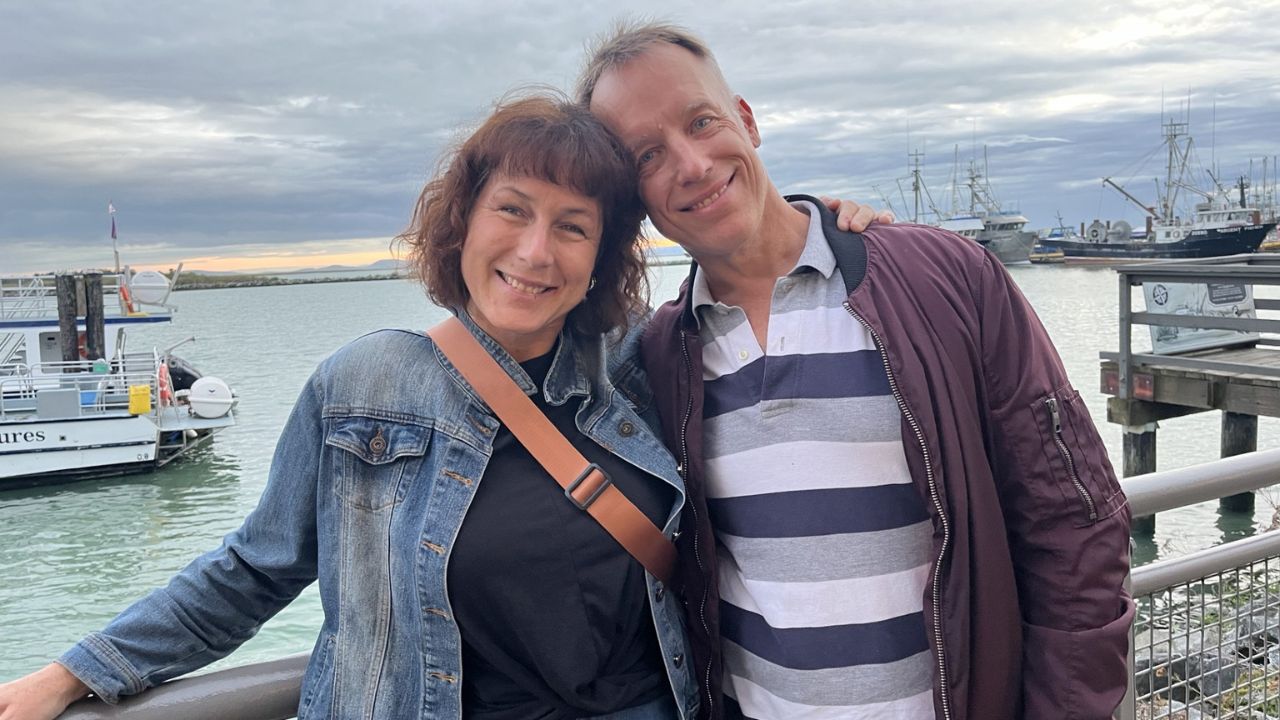
Andrew Reid and his wife, Karina, discuss what it was like to navigate posterior cortical atrophy (PCA), a rare form of Alzheimer’s disease that primarily affects visual processing.
Journey to Diagnosis is a Being Patient series sponsored by Eisai. As with all of our reporting, the sponsor has no role in choosing guests, shaping questions, or reviewing content before publication.
Andrew Reid was 56 when he was diagnosed with early-onset Alzheimer’s after unexplained changes that affected his work, driving, and daily functioning. He lives with a rare form of the disease called Posterior Cortical Atrophy (PCA), which primarily affects visual processing.
Before his diagnosis, Reid built a career in management and leadership as the founder and CEO of Big Fish Interactive, a leadership training firm focused on guiding organizations through positive change. He’s also a gold medalist in the European Dragon Boat Championships.
Reid and his wife, Karina, are committed to sharing their story to educate others about early-onset Alzheimer’s, reduce stigma, and amplify the voices of young families facing the disease. Reid said he has found strength in an improv acting group and has become a passionate advocate for others living with young-onset Alzheimer’s.
In this conversation with Being Patient’s Mark Niu, Andrew and Karina Reid describe the emotional toll of uncertainty and the importance of getting the right diagnosis. They discuss the realities of living with PCA and strategies for finding new forms of connection through humor, community, and creative outlets like improv.
Being Patient: Andrew, tell us about your profession. It was while you were working that you first started noticing these early signs?
Andrew Reid: I had no idea. All I knew was that I was slowing down in my productivity. The first thing that I noticed was how I was viewing the keypad was changing for me. And I would have to keep deleting and doing it again all day long. And then because I was losing so much time in the workday, I would go home and do more work, which obviously wouldn’t be a healthy thing in itself.
Being Patient: Did you keep some of those things to yourself, or did you tell Karina, or did you just not know what’s going on?
Andrew Reid: I was just trying to figure it out myself first. And there was no resolution of that experience that I was having. And so I just had to try to figure it out. And then it wasn’t too far after that that my director was noticing that I was slowing down. And I was noticing it also.
To avoid a difficult conversation with her, I led the charge and just said, “Hey, I know that I’m slowing down, and I don’t know why, but I want to let you know that I’m aware that there’s something that is hard for me right now.” And so those experiences were the beginning of my decline. And eventually I lost my job.
Being Patient: And at that point, Karina, did you also notice changes?
Karina Reid: Something was off in many ways. This is obviously the pandemic. So you try to think, okay, is he really stressed by the pandemic? Why is he working at home until two, three in the morning to do his work? And he was kind of just throwing himself into it.
I was also a full-time student at the time. So I wrote a paper, and I was like, “Oh, would you mind just reviewing it, see if you see any spelling errors?” Normally he was always that person that would do that for me. And he’s like, “I can’t.” And he didn’t really obviously know why he couldn’t. But at the time, with the symptoms for the PCA, when he’s reading, the words would jump out at him. So it was really difficult for him to narrow in on what he was reading and understanding.
Also, I would see things like if we’re going on a camping trip, he would try to pack up the car, but then that ability to be organized and pack up the car kind of fell apart. He could no longer put a tent together. And I thought, what is going on here?
But he did try to figure this out himself. I was seeing it, but I guess part of me thought it was maybe burnout dealing with the pandemic. So our road to diagnosis was a long time.
Andrew Reid: Yeah. And at that time, around the COVID stuff, part of my role in hospitals was supporting stressed-out hospital folks. And so I went to my family doctor, and she said, “hey, I think you’re just experiencing what all the other clinicians are doing. They’re all burned out because of COVID.” And we were basically at the end of COVID in those days.
And so my doctor really wasn’t any help because she just said, well, you’re like every other person coming around here every single day. You don’t display anything that’s unique. And because she knew that I was someone who was in charge of designing resilience programs. And so all that is happening at the same time. And so it made sense that an outsider would miss what was actually going on with me.
Being Patient: What are your steps after that? I mean, how long did it take to get a diagnosis? You were in your early 50s at that time, is that right?
Karina Reid: I mean, it really came down to a near car accident. I was like, “OK, enough is enough. You’re going to emergency today.” And that’s where everything started. He tried getting information by going to an eye doctor, and the eye doctor, of course, was like, “Oh, your eyes are fine.” But it was very unusual. I mean, he was a phenomenal driver, but he kind of just blanked out and totally zoned out in the intersection. And that really was very scary. Cars were coming at us. So that’s really when everything started moving quickly.
Being Patient: You were in the car with your kids, too, is that right? Tell us, Andrew, what you were going through and what you were feeling.
Andrew Reid: Yeah, it was a nice warm day. My kids were just doing a match for sports. And when we left the activity, I was driving home with the family in the car, and I was starting to turn the car to go down our road. And then my family started screaming because I was…
Karina Reid: You were kind of stuck in an intersection.
Andrew Reid: So I had cars coming for me from the other side, and I just had to freeze and let it solve itself. But that was terrifying.
Karina Reid: That was the last day he ever drove.
Being Patient: So you just blacked out, or what do you remember?
Andrew Reid: It was just like I totally zoned out for a second. I don’t think it was more than a second. It happened and stopped extremely quickly. So, yeah, very scary. But it was a really good thing at the time because it prevented a whole lot of other more dangerous stuff because I didn’t know what was happening.
Being Patient: So after that, then you made another appointment. Did you see a neurologist, or what happened from there?
Karina Reid: He went into urgent care and got an MRI done. And then that’s where he started the process.
In the beginning, he was first diagnosed with epilepsy, and then we’re like, oh, okay, he’s going to get medication. This is epilepsy, you know, you can get medication and you can have a great life. We just started joining all these groups, and we found that there’s a great support network for epilepsy.
But it just didn’t seem right. The short-term memory was kind of being challenged. There were lots of things that just didn’t connect to the epilepsy diagnosis. And then he was referred to, in Vancouver, our UBC hospital, which is a brain clinic for Alzheimer’s. And when she put that referral in, I kind of thought something else is happening here.
Being Patient: And then they diagnosed you. Tell me about that moment. And can you tell us what you know about PCA, which is an atypical form of Alzheimer’s.
Karina Reid: That was a devastating day.
Andrew Reid: I was being sent to a brain health clinic, so I knew that something was changing, but I didn’t think that it was going to be Alzheimer’s. And so that was horrid. The good thing about it was I was now getting the proper information from the doctors, and now we could get busy on treating the real thing.
That was great for me because I think for anybody with an illness, to not have any idea of what’s going on, the diagnosis is something where, even though it’s horrible, it’s a really good thing when you finally figure out what’s going on.
Being Patient: So the diagnosis is posterior cortical atrophy. And just to explain a little bit about that, posterior is exactly that. It’s in the back part of the brain, which is the cortical cerebral cortex, the outer layer of the brain, and atrophy is sort of a wasting away of tissue. That can affect the vision and putting complex images together. And in more than 80 percent of the cases, PCA is due to Alzheimer’s disease, which is in your case. But it can be due to other neurological conditions like Lewy body dementia or even corticobasal degeneration. And PCA is just accounting for approximately 5 to 15 percent of Alzheimer’s disease cases.
How are you affected by it right now? Vision is the main thing right now. Is that right?
Karina Reid: Yeah.
Andrew Reid: I’ve never really had problems with memory. It’s the visual stuff that’s really the thing, because it affects me. I don’t read to my sons anymore, that kind of stuff.
Karina Reid: He’s not able to figure out how to get dressed either, because it’s that processing of the brain to understand where to put his arm into his sleeve. So he requires help to get fully dressed.
Andrew Reid: That’s a huge impact every single day with me. I’m glad that it’s springtime now because winter is terrible for me because I have a hard time putting a coat on. So there’s all these day-to-day things that impact me completely.
Being Patient: And it’s interesting to note that I believe that it’s not your vision. Glasses or something are not going to help. Your eyes are actually fine. It’s just the way the brain processes.
Karina Reid: Yeah, exactly. Objects truly disappear. One time he walked into the living room and was like, “What do you want me to do with this lime?” And then he was holding it up as though he had a lime. And I said, “Oh, what lime?” And he’s like, “Oh, it disappeared.” And I felt so sad. But then I cracked a joke, “Maybe you should become a magician.” You kind of have to have a lot of laughter because it’s so bizarre.
We often joke that we live in the “Stranger Things” TV show, where you’re in this altered sense of reality. What is real and what are you seeing? So we kind of have this motto with the kids because Andrew will perceive something as quite real. And then we’re like, okay, Andrew, what you’re seeing is not kind of what we’re seeing. He may think he lost a tooth while he’s eating, and it’s very real for him. But then when we look, he hasn’t lost a tooth. So that processing part is quite overwhelming.
Andrew Reid: Yeah, it’s very bizarre.
“Even though it’s horrible, it’s a really good thing when you finally figure out what’s going on.”
Being Patient: How do you emotionally handle it when you find out, say, it wasn’t your tooth or something? Is it easy to trust anybody else, like Karina telling you that, or is there a sort of defensiveness about it?
Andrew Reid: Yes, well, that’s where it starts, is to say, “What do you mean? I know that I crunched down on my tooth today at lunch.” So these things that my brain is telling me are happening really aren’t. So it took me a couple of days to get my head around it. But then I just realized it was just another thing that is bizarre that nobody would understand. So, yeah. It’s make-believe.
Karina Reid: Also, quite interestingly, with this disease, one side is far more affected than the other side. So the left side of his eyesight is more affected, the left side of his hearing is more affected. So that’s another thing with the visual processing.
We were out walking or on a hike the other day, and his body, his brain, works very hard to process uneven ground. And then his body will slump over to the left because that’s a weaker side. And I’m like, “Your body is completely gone over to the left.”
Andrew Reid: My youngest son was just like, “Dad, you’re tipping over.” And so he walked over on this hike and he was trying to push me up again, but I wouldn’t stay there. So that’s very bizarre.
Being Patient: How have your kids been able to process what’s happening?
Karina Reid: It’s very difficult because when you see Andrew, there’s so much about him and he’s just Andrew. But then when you see some of these things at home, it’s just really kind of frustrating. There’s a lot of anger, not understanding this is his illness. He’s not doing this to be annoying and make messes all the time. It’s part of the illness.
I think our children are going to end up being probably some of the most compassionate people in the world because they’ve seen their dad change and continue to change. But it’s been a hard journey of a lot of grief. It’s different stages of grief.
Being Patient: What are some tips that you can offer? What did you find most useful?
Andrew Reid: Yeah, with the stairs in our house, we put down some sort of sticky markers so that I could track where I need to go up and down the stairs. And that works well. It’s red stuff on the floor.
Karina Reid: Because the stairs for him disappear. So the red you’re able to track. We also have red stickers on light switches. For eating, we have red plates that have edges, red cutlery with grips, and red toilet seats. We have a lot of red. But it works well. He’s able to track it.
Andrew Reid: The other thing that I sometimes forget to talk about is that I’ve had a huge change in going downstairs. Depth perception has really changed significantly, especially this year. And so I just have to be careful.
But I have a pattern of getting around and going to see people and stuff. So I know what to look for. But I am always on alert to make sure that I’m not just taking half a step too far and coming off the edge of a curb or something like that. So I have a lot of mental stuff that regular people wouldn’t be having. But I’m not really bothered by it now. It’s just a lot of energy from a standard person.
Karina Reid: Also walking, he’ll track movement, not necessarily the people. Often he may blend in with a different family and think it’s us. Or if we’re like, let’s do a family picture, he may end up going beside somebody else for the picture. Even when you take a picture, you almost have to prop his body up and then have somebody wave so he understands where to look.
[We] learn what works for him. I know enough that when he is eating or if we’re at a restaurant, he can only have one plate and one glass of water. It cannot be a busy area. It cannot be overstimulating because then he’s lost in figuring out what is what.
Being Patient: And what about exercise, and especially to prevent falls? Andrew, I read that you were an elite athlete, a rower, being part of dragon boating at an extremely high level. Tell us about that, and then how have you had to adjust your workout routine to make sure that you’re safe?
Andrew Reid: Yeah, up until this past summer, I’ve been racing sprint canoe and dragon boat. My team placed fifth in the world in Macau one year. Our Canadian men’s team with me raced in Sweden. And we won everything. So a lot of huge, wonderful experiences. It gave me opportunities to travel a lot in Europe and all that kind of stuff.
All that kind of stuff has now stopped. And I think actually what we were talking about — different sides of my body and how it’s been changing. This summer, I was asked to step down from the Dragon Boat team because I was slowing down. And now that I understand that my body is doing different things on either side, that makes sense that I was slowing down because if one side of my body isn’t paddling at the right tempo, I’m going to put everybody else in jeopardy for their performance.
Karina Reid: When he was not able to do that anymore, we got a Peloton bike and he does indoor cycling, and he will still go for runs. And once that kind of chapter ended, he joined an improv group, and he loves improv. Improv acting group.
Andrew Reid: Yeah. Perfect stuff for me.
Being Patient: How does that help? And improv is not easy for anybody, but what are the challenges outside of lines? How does it make your brain work? Because language is affected, and tell us how that’s affected. And then how does improv challenge you?
Andrew Reid: So I had done a fair bit of improv years ago. And so the past year I got back into it, and it’s awesome. And it can be very hilarious. But the key logic or commitment with improv is there are no rules except you have to set up your partner in any sort of setting to set them up for success. But you can’t really do anything wrong. And so it’s a really safe place. It takes people a few times before they feel comfortable doing that.
But it’s a wonderful experience where you can’t do anything wrong. There’s no precision. There are different types of activities in any improv setting, but, yeah, I go every week and we have a great time.
Being Patient: For other individuals or couples who may be at the beginning of a confusing diagnosis journey, what would you want them to know?
Andrew Reid: You have to tell them that they’re not nuts and that being linked with a rare type of dementia can really change the whole experience of somebody. It’s really important to get them the right information at the right time and help them and their families and so on.
Because even if we’re missing little bits and pieces of what’s going on, any of that little bit of loss is also very compounding. And for me, I really stopped trusting myself with so many activities and so on. I just didn’t know what was going to happen next. So there’s a lot of anxiety, like just walking down steep stairs in a building. And so there are risks. But because of being taught by a bunch of clinicians, I knew that there’s always a risk for falls, and so I fortified my brain and my activities so that I can catch myself if something happens.
Being Patient: Karina, any final words as a caregiver, advice?
Karina Reid: I think I’ve learned so much through my husband’s resilience. I mean, he has the motto for life: every day is race day. And I really think that this disease, there’s a lot of unknown, and you’re really navigating uncharted waters. I use the analogy of a river, like we’re often paddling upstream and not sure sometimes which way we’re going to go, but we’re still paddling together. Our roles have changed. I might be the one steering the canoe now instead of him.
Once you sort of let go of the grief, and you move through the anger, and then you come to the acceptance part of the disease, and realize your person’s still there, like he’s still my partner, he’s still my husband, just things look very, very different.
I really can’t say enough about laughter. There are hard days. He talked about getting his jacket on. Sometimes hanging the jacket against the wall and he’s trying to get in, and we’re like, this is so crazy, we end up videotaping ourselves. And then we’re laughing in absolute hysterics about it.
Also finding your community. Did I think I was going to be a caregiver at 50? No. But finding your people and reaching out and asking for support because this is a lonely disease. You feel quite alone a lot. And so often I have people say, how can I help? And most of the time I really don’t know what to say in return because sometimes I don’t know. And I’m just overwhelmed in even having to answer the question. My advice would be for anyone: just show up. I don’t know, make me a meal. Or make my family a meal.
I think this is a hard road, and I’ve been tested in ways I didn’t really think I had the strength to do, and I sometimes still don’t know how I will do it. But I love him to pieces, and I will show up in ways I can, to support him in the best way.
Andrew Reid: I’ve been given a really good community of support. There’s a lunch group — they do not have my type of PCA, but they’re all my age. And we have a great time, and we do it every week. And that kind of community with people that are experiencing similar things means that the laughter and the love can come out of that.
“Once you sort of let go of the grief, and you move through the anger, and then you come to the acceptance part of the disease, and realize your person’s still there, like he’s still my partner, he’s still my husband, just things look very, very different. “
Being Patient: Karina, what resources have been most helpful to you?
Karina Reid: So I live in Canada. Rare Dementia Support Canada is an organization — I think it started in the UK. They’ve been really quite great on specific resources for PCA. They have a whole section on their website for PCA. And then there’s a section on PCA tips. And that’s where I learned a lot about how to make the home safer for him. PCA tips were phenomenal.
Also, my Alzheimer organization here has been really great. But I think because it’s such a rare disease, looking at Rare Dementia Support UK, Rare Dementia Support Canada, there are some really good resources.