When Words Fade: Samuel Valverde on Living With Primary Progressive Aphasia
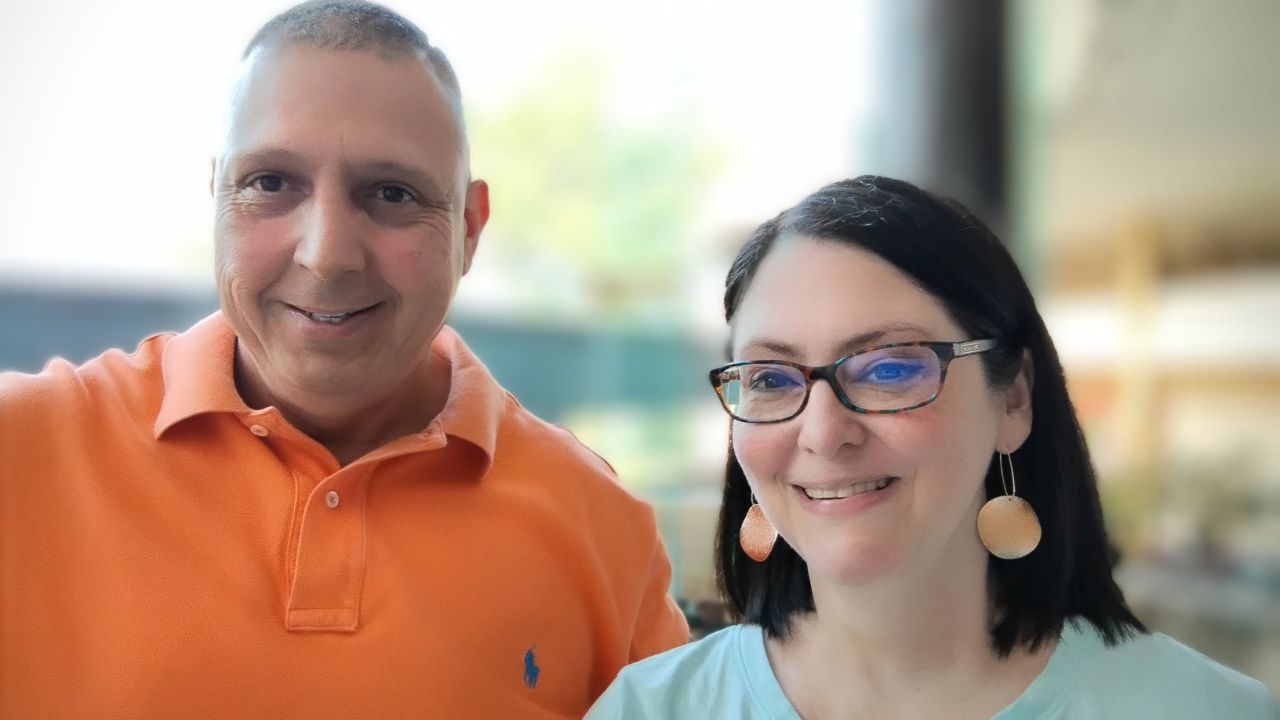
Samuel and Heather Valverde reflect on early signs of primary progressive aphasia, the road to diagnosis, and how they are navigating caregiving and advocacy together.
Journey to Diagnosis is a Being Patient series sponsored by Eisai. As with all of our reporting, the sponsor has no role in choosing guests, shaping questions, or reviewing content before publication.
Samuel Valverde had built a career on precision and discipline. A Desert Storm combat veteran and longtime law enforcement officer, eventually becoming police chief in Waelder, Texas, he was used to staying sharp under pressure. But over time, small cracks began to appear: missed court dates, details slipping from reports, and a growing struggle to focus, plan, and keep pace with the job he once handled with ease.
In 2022, while receiving treatment for PTSD, Valverde’s psychologist flagged concerns that went beyond trauma, including changes in his speech. A referral to a neurologist set off months of evaluations: cognitive testing, speech therapy, multiple MRIs, and a PET scan. Which resulted in a diagnosis, when he was 53, of primary progressive aphasia (PPA), which affects language abilities.
In this conversation with Being Patient’s Mark Niu, Valverde and his wife, Heather, reflect on what it means to face primary progressive aphasia as a family — from recognizing early changes to adjusting to life after diagnosis. They speak candidly about the emotional impact of the diagnosis, the shifting roles and challenges that follow, and the resilience required to move forward together.
Being Patient: Tell me, Samuel, you’ve lived an interesting life, starting off with the military.
Samuel Valverde: I was diagnosed with primary progressive aphasia in 2022. I was in the military for nine years, and I was in law enforcement for 15 years. I think a lot of it, I was in denial. Initially, I didn’t go to the VA to follow up on some tests, to follow up on some medical stuff. I thought If I [was physically fine], if I had all my limbs, I didn’t want to accept anything that [there was an issue] inside my brain or anything. But years later, it developed, and I couldn’t run from it.
Being Patient: In your service in the military you were in Operation Desert Storm, right? Did any of that impact your brain health?
Samuel Valverde: Definitely. The concussions, the explosions, even the exposure to the different stuff that we were exposed to, I think played a big part in what’s taking place now. And that’s not just myself — that’s for other veterans.
The facts, if I understand correctly, a lot of the veterans that were in that war, they’re gone. A lot of them have died in their 50s. A lot of it has to do with exposure and a lot of different reasons.
Being Patient: So there’s obviously post-traumatic stress disorder but maybe that there are other things that you’re exposed to, like chemicals and things like that, that you believe might be part of this?
Samuel Valverde: Oh, absolutely. It’s been proven now that the stuff that we were exposed to — the oil that was burned — it’s a whole gamut of stuff. And we took some medication that, I think, hadn’t been approved. Well, there was discretion about it. And a lot of the chemical stuff we’re exposed to had a lot of delay. I myself have a lot of other issues — intestinal issues — as well as just a long list of stuff.
Being Patient: Even after serving, you were able to come back to civilian life, and you worked in the police force, and you ascended very high to the top, becoming a police chief.
Samuel Valverde: I come from a poor family, and my parents instilled in us a really solid foundation in Christ. And my dad instilled a really hard work ethic growing up. And I’ve always been very driven. I always wanted to be a police officer and wanted to be a soldier. Maybe not in that fashion, but I was very driven, and I’m service-oriented.
War changes you in ways. In my experience, I didn’t want to accept that change. I didn’t want to acknowledge PTSD. I didn’t want that in my life. And I was in denial. I thought that I came back in one piece and not missing any limbs, and I thought that I’m good.
But the mental stuff is something that doesn’t go away. It’s not going away. You can run from it, but eventually you’re going to have to deal with it. And that’s what happened to me. I ran from it for many years. And the stuff that I learned in the military — the tactical stuff — it helped me in my profession because I became a workaholic. I devoted myself to that field — and I excelled when I was there because I loved it. Both of those professions I did, I probably could have done without getting paid because I was very passionate about it.
But it was only when I was getting treatment for the PTSD and we noticed that at work I was missing court dates, I would refer to people by the wrong name. There were a lot of word-finding issues.
And the PTSD therapist that I was seeing, she noticed it. My wife noticed it. There comes a point in time where you can’t mask it. I was really good at masking things, but I worked doubly hard at it. And that’s one of the reasons I excelled, because I just worked harder than the next person. I really refused to let things take over. And I think that helped me. But there comes a time when you make mistakes. It just comes to a point in time when you, and others, realize that you need to get help. And so that’s what happened.
Being Patient: And Heather, what were you noticing at this time? What were the early signs that you started noticing?
Heather Valverde: The first sign that I noticed was a change in the rate of his speech, and that it was different than it had been. And then I also noticed that he was forgetting names — names of people that are close to us. He would forget the names of objects, and he would just constantly throughout the day ask me, “What do you call that?” And so that was the first indication to me that something was wrong.
Samuel Valverde: I think one of the things that I want to mention is that what we have experienced — and this is through the journey that we’ve gone through with this diagnosis — is that it affects different people in different ways. In my case, it doesn’t take away your intelligence. I always knew what I wanted to say, but sometimes [I couldn’t find my] words.
We used to joke about it, because I’m bilingual. And so I said, “Sometimes my English runs out.” And it was humorous, until it wasn’t, because the words didn’t come naturally. I had to struggle, but it just got progressively worse. And so it’s something that we had to work with.
“In my case, it doesn’t take away your intelligence. I always knew what I wanted to say, but sometimes [I couldn’t find my] words.”
Being Patient: You speak Spanish and English?
Samuel Valverde: Yes, sir. My mother’s from Mexico. I grew up speaking Spanish way before I spoke English.
Being Patient: Do you revert to more Spanish? I mean, how does it affect which language you’re speaking?
Samuel Valverde: I think some of the stuff I recall is more in Spanish. But the thing is that I learned English at such an early age, even before I was going to school.
Being Patient: For people who haven’t heard of primary progressive aphasia, how would you describe what it’s like to experience it?
Heather Valverde: Well, the doctor explained to us, with a really good illustration, and she’s like, “Your brain is a file cabinet. And the words are like the folders, and your folders have fallen onto the ground. That file cabinet’s been dumped onto the ground, and you’re trying to pick up those folders to try to find the correct word.”
Samuel Valverde: It can be very frustrating because we can have a conversation sometimes, and then there’ll be times when I can’t follow a conversation after two to three sentences. It’s very degrading because it affects your words, which affects your speech.
Being Patient: What was the diagnosis process like?
Heather Valverde: My first thought is it was a long time coming, but this wasn’t on our radar at all. And so when Samuel’s PTSD doctor noticed that she thought that there was something more neurological going on, we were referred to a neurologist. And then that’s when the testing started, like the PET scan, the MRI, cognitive testing. But even when we got the results of the PET scan, we didn’t even realize that he was being tested for dementia.
Samuel Valverde: She was treating me for PTSD, and she said, “That’s not just PTSD. There’s something else going on here, other than the PTSD.” And that’s where, fortunately, that’s what began our journey.
Being Patient: We’ve actually got a question from a listener: Do you find that your comprehension of words spoken by others has changed? For instance, do you want people to speak more slowly or speak simpler?”
Samuel Valverde: Yes. However, I have found that I’m not as involved in a conversation as much. Usually my wife is talking, and I try to not do that, but you can’t help it because there’s been times when you accidentally say something that has either already been said, or you repeat yourself, or there’s all kinds of odd things in it. My wife’s helped me a lot with the interactions and stuff.
This affects people in different ways. Until you get to talking, a conversation, and until you get to know them, they may not exhibit or display these symptoms. But rest assured that there’s a lot of preparation. Wherever we go, whatever we’re doing, we spend more time prepping, preparing for outings or for anything.
Being Patient: Tell us about when you received the news and, Samuel, your thoughts on the diagnosis.
Samuel Valverde: It wasn’t on our radar. Fortunately, the right doctors picked up on the clues and the symptoms. When you’re first told this diagnosis, it is a real gut punch. It’s a sucker punch. It will drop you to your knees emotionally. No one asked for this. No one prepares for it.
But we found through our journey, fortunately, that the sooner that you recover from that initial gut punch, the sooner that you shake it off, the sooner that you engage. That helped us, and it changed our journey. Because you can’t go through this alone. There’s people that do it. I don’t know how they do it, but I’m blessed with a special wife. Caregivers are just the backbone. But you have to reach out. You have to reach out and be resourceful. Because the more you learn, educate yourself, the more you find out, the better off you’re going to be. You’ve got to arm yourself with tools, and that’s what we do.
“…the sooner that you recover from that initial gut punch, the sooner that you shake it off, the sooner that you engage.”
Being Patient: What age were you diagnosed at?
Heather Valverde: He was diagnosed at 53.
Being Patient: What are some of the communication strategies or supports that have helped most, whether that be speech therapy or certain routines?
Heather Valverde: Speech therapy has been so helpful. It’s been more strategizing with speech therapy, how to try to determine the context of what’s being said, different skills to come up with that word that you’re searching for. And then he also has a tablet that’s a communication device. So he can put images of different objects, people, and it records the word for him. So he can push the picture and it will tell him the word that he’s looking for, so he can hear it, too. And that’s been very helpful.
Being Patient: For couples who are just beginning this journey with diagnosis, what conversations would you suggest, or maybe do you wish you even had sooner, to talk about planning or roles? Give us your advice on that.
Heather Valverde: Well, the role reversal is definitely very hard, because it does change. And I don’t think that we were prepared for that, but just working together.
Samuel Valverde: She’s basically stepped up and had to do things that I can’t do anymore. She has to hire people to do certain things. I can’t keep up with things. I can’t plan. I can’t organize very well. And then the simplest things with the cognitive stuff, it’s degrading when you are declining. It’s very degrading. Because you were at a level at one point, you could do many things. You could multitask. You could do so many things. And now you struggle to do certain things, and it’s very aggravating and very agitated. It’s devastating. And it’s something you’ve got to adjust to. And that’s one thing that we would like to tell people that are new: Have grace. Have grace — the caregiver as well as the person diagnosed. I think in any marriage, you’re going to have grace. And it’s OK. You’re not given a rule book. So allow yourselves some grace.
Being Patient: Heather, as a caregiver, sometimes people forget how much support is needed. What are your thoughts on being able to manage yourself, to make sure that you are supported in what you do?
Heather Valverde: Yes. I think that it’s very important that you have to take care of your own mental health. And sometimes when you are dealing with a partner with dementia, it can feel like you’re thinking for two people. And I just can’t stress enough how much you’ve got to put that oxygen mask on first before you can help your partner, and you’ve got to take care of yourself.
Being Patient: Any final words of advice for people that may be newly diagnosed and supporting a loved one through dementia?
Heather Valverde: I think that it’s important also to grieve the loss and acknowledge that there is a loss, and to be aware of your feelings and process your feelings. And then you can move on, but allow yourself to mourn a loss before moving on.
Samuel Valverde: There’s a lot of resources out there that you could reach out to, and that’s what we encourage — the clinical trials. Just educate yourself and reach out to people, because no one should go through this alone, and they shouldn’t have to. There’s resources out there, but you’ve got to take the initiative and take the step and follow through. And you’ll be surprised how encouraging it is when you meet other people that are so inspirational.