CES 2026 Highlights the Future of AgeTech, From Fall Prevention to AI Monitoring
Being Patient’s Mark Niu hits the showfloor to search for the coolest new technology designed to support older adults, caregivers, and people living with dementia.
One of the world’s largest tech conferences CES wrapped up in Las Vegas earlier this month with technology for older adults playing an increasingly large role. The show featured an inaugural AgeTech booth and a full AgeTech Summit.
Here’s some of the agetech that caught my eye:
Fall Prevention Footwear
Seeing shelves filled with sneakers, I expected the shoes on display to be outfitted with all kinds of sensors to monitor health readings. But it turned out to be a different kind of technology that was based solely on prevention. Cadense shoes are designed for anyone who struggles with foot dragging, which includes post-stroke patients and people with Alzheimer’s who struggle to clear the floor.

The Cadense shoe is designed to reduce foot dragging
The shoe has raised nylon pads on each side of the sole to help feet glide smoothly over uneven ground. The curved rocker sole shifts naturally from sliding to gripping as you walk. The front of the sole provides a solid grip when stopping or pushing off.
“If the shoe grabs and your body is moving forward and you have a forward tilting torque, that can result in a fall,” said Cadense founder and CTO, Tyler Susko. “We have this shoe that will be able to slide in front so that you restore your base of support. And then as soon as you put your weight on it, it grabs.”
Susko is a Mechanical Engineering Teaching Professor at the University of Santa Barbara. His idea stems from his work as a PhD student at MIT, where he developed robotic technology that walked on a split-belt treadmill.
“In that study, people were telling me it’s so much easier to walk if I don’t have to worry about hitting the floor when I’m walking. So the next ten years were devoted to ‘How do we take the feeling of this giant robot?’” Susko said. “So we went from a one million dollar robot to a $200 shoe. The shoe doesn’t get rid of the floor, but it minimizes the consequences of the floor by reducing the friction.”
Detecting Falls Privately
In order to monitor those with dementia, caregivers are increasingly equipping rooms with livestream cameras. But people being taken care of aren’t always fond of being monitored via video 24-hours a day.
That’s why Pontosense’s Silver Shield uses radar devices about the size of a coke can to detect movement.
A typical home would have three of them mounted to walls — one each in the family room, living room, and even bathroom.
“I’ve never met somebody that wants to install a camera in their bathroom,” said Clayton Moore, an account executive with Pontosense. “Because we are 100% radar driven, there’s no need for cameras, there’s no need for microphones. You don’t even need to wear a watch or a pendant, for example, that you might forget to charge. The radar driven technology is just a great way to provide that peace of mind while maintaining people’s privacy with their dignity.”
Pontosense currently works with long-term care homes, in-home care agencies and other partners to distribute their sensors, which work remotely via wifi. An app can immediately notify caregivers of falls.
“Our radar technology is going to monitor about 25 data points around the person. So you can see up all the way from upright to hitting the deck into what we call a hard fall,” Moore said. “But beyond that, a lot of falls are a little bit simpler. You might just be tying your shoe and topple over. We can still monitor that just to make sure people can actually get up.”
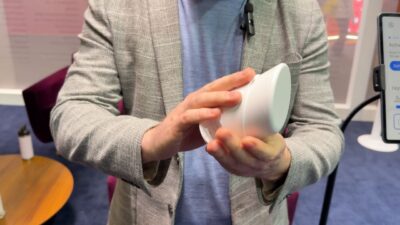
Pontosense sensors aim to detect falls while maintaining privacy
Stimulating the Mind
Other technology at CES focused on keeping those with dementia active mentally.
Avadin is a small, stationary companion robot that waves its arms and smiles with a cartoonish face that appears on a touchscreen. It can remind users to take their medicine, sleep, and have their meals.
“We are here to try to stop dementia from progressing,” said Louis Lee, CMO of Wonderful Platform, which is a South Korean company. “We utilize these brain quizzes, activities, exercise games to enable the elderly to be more active daily.
The platform can also be used for remote monitoring and to provide daily activity reports to caregivers. The data collection also has a unique dual purpose — turning that information into an autobiography.
“It picks up whatever conversations you have with the elderly and the robot and it stores it as data,” said Lee. “And once it stores the data, maybe three months, six months up to a year it automatically generates our analysis into an autobiography where they can pass this autobiography as a book and print it out and give it to siblings, peers or family members as a memoir.”
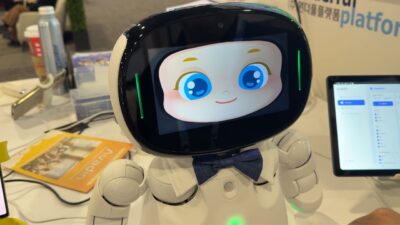
The Avadin companion robot helps create mental stimulation
AI check-in with your loved ones
Checking in with your loved one every day can be challenging for caregivers who are busy managing their own personal and work lives. That’s why Costin Tuculescu believes it’s a job perfect for AI.
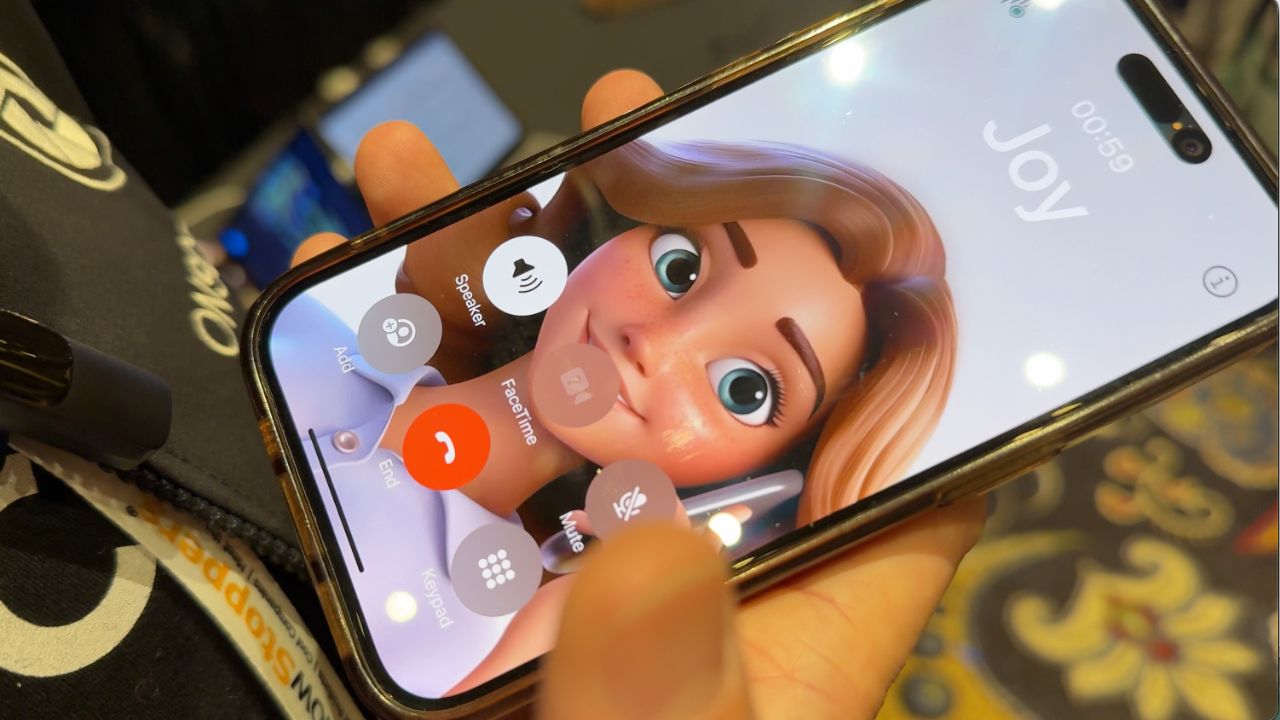
He’s the founder of JoyCalls, an AI agent that makes phone calls to your loved one while keeping you in the loop. It can ask questions and listen to the recipient of the call for a length of time that the caregiver chooses.
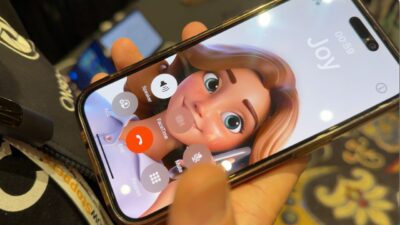
JoyCalls uses AI to make check-up calls on loved ones
“As long as they’re still able to have a conversation, even if they’re repeating the same story, it’s almost perfect for that because it engages them,” Tuculescu said. “It helps maybe reminisce, go down memory lane in a way that might actually be frustrating to someone to hear the same story over and over again. Joy has no problem with that. And it helps support that elderly person.”
The caregiver can choose the time of the call and the type of call, such as whether it’s a wellness check, a medication check, a meal check, or just a friendly chat.
“The family caregiver gets a summary text message or email, so there’s full transparency for the family member,” said Tuculescu. “If on that call there is some kind of emergency- I’m having chest pains, I feel like I am falling down. Joy will encourage that person to hang up and call 911, and then will send an SMS text message or email to the family caregiver.”
Despite using cutting-edge AI, JoyCalls is following the CES Agetech trend of making hi-tech as low-tech as possible. It works without an app or even wifi. All that’s required is a phone line.