My Five Takeaways From the World’s Largest Alzheimer’s Conference
From new blood tests and tau-targeting drugs to promising treatments for agitation, here are the discoveries — and unanswered questions — that stood out at this year's AAIC.
Deborah Kan is an award-winning journalist and founder of Being Patient. In this “Thought of the Week” column each Friday, she highlights one of the key stories shaping the future of brain science.
Dear readers,
We are in a bit of a waiting period for the next phase of drug development for
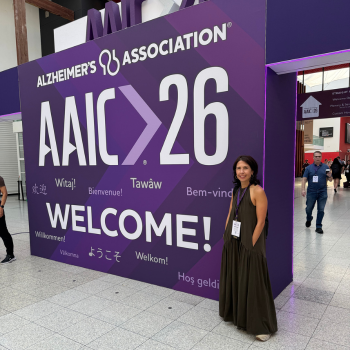
Alzheimer’s disease. This week I attended the Alzheimer’s Association International Conference (AAIC) in London, where researchers are working towards a world where multiple treatments are aimed at different targets of the pathology.
It was also encouraging to see several behavioral drugs in the pipeline for mid to late stage patients who have few alternatives. After multiple conversations and meetings, I’m leaving exhausted but hopeful. Here are some of the key takeaways that stood out to me:
1. Blood tests: should you get one if you have no cognitive symptoms?
This is the question I am asked by quite a few people in our community and an issue that is being discussed amongst the scientific community. I asked Dr. Marwan Sabbagh, a neurologist at the Barrow Neurological Institute for his take.
For people without symptoms, his answer was no. Not yet. The field still does not know what a positive result means for someone who feels completely normal. Dr. Sabbagh told me he now has patients who are biomarker positive and clinically fine, and they are terrified, certain they will get Alzheimer’s when the truth is that no one can tell them that for sure. He mentioned hearing a brand-new phrase at this year’s conference: “cognitively unimpaired Alzheimer’s disease” — a term he had never encountered before.
2. How well do these tests actually work?
We are only at the very beginning of understanding how well blood tests perform in the real world, and whether being tested actually leads to better outcomes.
At AAIC, Dr. Sebastian Palmqvist of Lund University shared encouraging data that a blood test helped primary care doctors reach the right diagnosis and, just as usefully, rule Alzheimer’s out. But other neurologists at the same conference argued the tests should be ordered only by memory specialists, because they have already watched them get misused and generate false positives. One JAMA Neurology study even found an FDA-cleared test was less accurate than advertised.
The tests are advancing quickly. Now we need real-world evidence to prove their reliability.
The tests we have also only look for Alzheimer’s. My mother’s autopsy revealed she also had LATE, a form of dementia that often travels alongside Alzheimer’s and, right now, can only be confirmed after death. That is starting to change. Researchers are developing a blood test for a protein called TDP-43, the one that builds up in LATE, and while the work is still early, it points toward a day when families might learn what is actually driving their loved one’s disease while they are still alive.
3. Treatments for tau?
For years, amyloid has dominated the Alzheimer’s headlines but scientific consensus is moving towards a multi-targeted treatment. Targeting tau tangles is the next frontier and Biogen’s tau-silencing therapy diranersen is moving into Phase 3.
As Being Patient reporter Simon Spichak reports this week, the drug, administered via intraspinal injection, is a small string of genetic code that silences the signal that tells cells to build tau proteins.
4. A surprising result for late-stage agitation
For families moving into a later stage of Alzheimer’s, the most urgent question is rarely about a future test. It’s about agitation, the pacing and distress and aggression that can surface in the later stages and can be one of the hardest things a caregiver ever faces.
Positive results were reported in a Phase 2 trial called LiBBY, testing a specific THC and CBD combination in 120 people with dementia and agitation in or near hospice care. More than 80 percent of those on the treatment improved within two weeks, versus 30 percent on placebo, and the benefit held at 12 weeks. Dr. Jacobo Mintzer, who presented it, said he had never in his life seen an 80 percent response at two weeks in any study, about anything.
The study was small and a Phase 3 is being planned. Also important to note that what they tested was a precise pharmaceutical formulation, not anything you can buy at a dispensary or gas station! A few other agitation and psychosis drugs are also advancing into a later phase.
Best way to monitor your brain health
For my own information, I pulled aside my friend Dr. Nate Chin from UW–Madison and asked him what he thought was the single best way to monitor your brain health. His answer? Buy a blood pressure cuff.
I laughed. Surrounded by the most advanced Alzheimer’s science in the world, and the best advice I left with was a click away. Check three times a week. Aim to stay around 120 over 80. That is it. Your brain health runs through your heart and your blood vessels.
Keeping your blood pressure in a normal range is one of the most consistent things you can do to protect the vessels that feed your brain. The advice was convincing enough that I got onto Amazon and ordered a blood pressure monitor that will be waiting for me when I return home.
With hope,
Deborah