The 10 Most Popular Live Talks of 2025
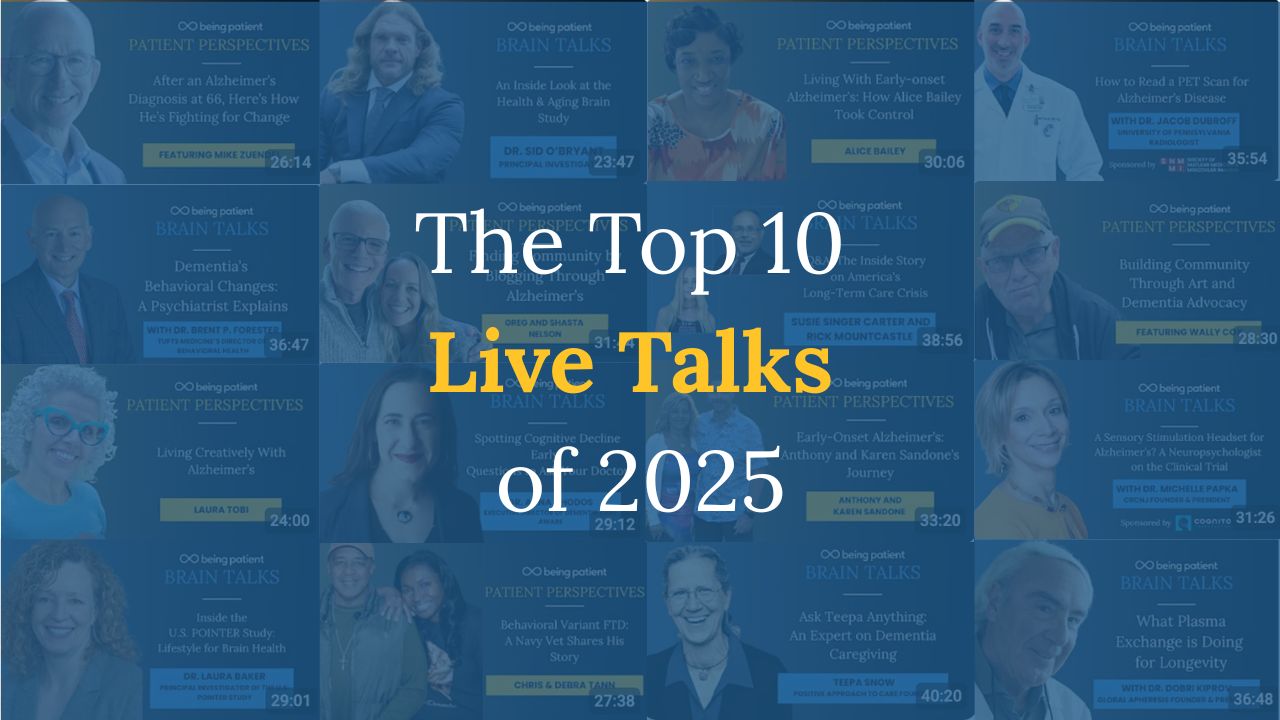
From dementia behavior changes and sensory stimulation trials to cortisol, screen time, brain imaging, and early detection — here are the 10 Being Patient Live Talks of 2025 you watched and shared most.
At Being Patient, we host regular LiveTalks with experts, advocates, and people living with Alzheimer’s and other forms of dementia to deliver trustworthy information and answer viewer questions in real time. Throughout 2025, thousands of you tuned in from around the world to watch live, catch replays on YouTube, or read our coverage of each conversation.
Our Brain Talks series featured accessible interviews with leading researchers, clinicians, and other experts on brain health, dementia science, treatments, and care.
We also hosted Patient Perspectives interviews which featured candid conversations with advocates and people living with a dementia diagnosis about what life looks like after diagnosis. These talks often explore early signs, daily challenges, and the strategies people use to live well with a diagnosis.
In our annual roundup, we’re revisiting the Live Talks you watched, shared, and discussed most last year:
Dementia’s Behavioral Changes: A Psychiatrist Explains
Behavioral symptoms of dementia, like agitation, paranoia, depression, and anxiety, can be challenging for caregivers and people living with the disease to navigate. In addition, when some people are experiencing early signs of cognitive decline, sometimes they can be misdiagnosed with depression or anxiety, and it takes years to receive an accurate diagnosis.
So, what do we know about dementia and the reasons for these behavioral and psychiatric symptoms?
Tufts University’s Dr. Brent P. Forester joined Being Patient founder Deborah Kan in a conversation about how dementia can impact behavior and the importance of seeking a diagnosis. He’ll also discuss the connection between depression and dementia.
Read the full article here:
A Sensory Stimulation Headset for Alzheimer’s? A Neuropsychologist on the Clinical Trial
Researchers and technology companies are investigating whether non-invasive electromagnetic, visual, and auditory stimulation can treat Alzheimer’s disease. But what do we know now about these emerging non-drug interventions and what they can do for the brain?
Cognito Therapeutics is probing the connection between visual and auditory stimulation and gamma waves in the brain and treating Alzheimer’s disease with an experimental headset called the SPECTRIS AD.
Dr. Michelle Papka, founder and president of the Cognitive and Research Center of New Jersey (CRCNJ), was principal investigator of the HOPE study Phase 3 trial and advisor to Cognito Therapeutics. Involved in Phase 1 and 2 or the trial as well, she sees the technology’s potential as a key part of potentially treating Alzheimer’s disease in the future.
Papka joined Being Patient founder Deborah Kan for a conversation about the trial, the science behind neuromodulation, headsets like the Spectris AD, and the future of this type of treatment. Read or watch the full conversation below.
Read the full article here:
How One Woman Took Control After an Early-Onset Alzheimer’s Diagnosis
When Alice Bailey was diagnosed with early-onset Alzheimer’s at 56, some of the challenges were all too familiar. She had witnessed her mother’s experience with Alzheimer’s years earlier, and recognized some of the same gaps in care and communication with her diagnosis.
Receiving no resources to help her process her diagnosis, she leaned on family, faith, and community to find support. Today, she’s a member of the Council of Black Dementia Minds, where she shares her story and helps build awareness about dementia in communities that are often underserved.
In this Live Talk with Being Patient’s Mark Niu, Bailey reflects on the moment she knew something was wrong with her memory, the frustrations she faced in the healthcare system, and the steps she has taken to live well despite her diagnosis. From addressing the stigma of early-onset Alzheimer’s to advocating for greater awareness in the Black community, she continues to use her voice to inform others.
Read the full article here:
The Double-Edged Sword of Cortisol: When Stress Hurts — and When It Helps
Stress is an unavoidable part of life, and with it comes cortisol — a hormone often vilified as a driver of anxiety, sleep disruption, and other health problems. But cortisol is more than just a “stress hormone.” In the right amounts and at the right times, it can actually help the brain encode certain memories more vividly.
This dual nature of cortisol — harmful in excess, helpful in balance — is at the heart of recent research by Dr. Elizabeth Goldfarb, assistant professor of Psychiatry and Psychology at Yale University. As director of the Cognitive Neuroscience of Affect, Memories, and Stress Lab, Goldfarb studies how stress changes the way we remember our lives, and what those memories mean for our behavior.
Goldfarb recently sat down with Being Patient founder Deborah Kan to unpack the complicated issue of stress and the brain, and answered questions about how much cortisol can influence memory.
Read the full article here:
Mike Zuendel: ‘Don’t Call it Dementia!’
Mike Zuendel’s search for his missing cell phone resulted in a trip to the doctor. Forgetting words and misplacing items were clues that something wasn’t right. With a family history of Alzheimer’s and confirmation of his ApoE4 genetic status, he sought answers. That journey led to a diagnosis of MCI due to Alzheimer’s, but it didn’t stop him. Instead, Zuendel leaned into advocacy and treatment, determined not to let the disease define him.
In this conversation with Being Patient Founder Deborah Kan, Zuendel opens up about navigating the diagnostic process, the hope he found through treatment, and his mission to change how we talk about cognitive decline.
From starting a monoclonal antibody therapy to launching a nonprofit aimed at eliminating the stigma around the word “dementia,” Zuendel shares what it means to live well after an Alzheimer’s-related diagnosis.
Read the full article here:
How Much Screen Time Is Too Much? The First MRI Study of Kids’ Brains and Digital Media Use
Screens are everywhere in modern society. The smartphones we carry in our pockets. Our laptop computers. Televisions. Car dashboards. Even many grocery stores now have them at self-checkout. And research shows the average American gets hours of screen time every day. There’s no question all these screens are affecting our brains. The only question is how.
Dr. John Hutton has some answers. Hutton is an associate professor in the Division of General and Community Pediatrics at University of Texas Southwestern Medical Center and a primary care pediatrician at Children’s Health, Dallas. Over the course of the last decade, Hutton and a team of researchers published the first studies in the world using MRIs to show the relationships between digital media use and brain function and structure in preschool-age children.
Hutton sat down with Being Patient founder Deborah Kan to unpack the complicated issue of screen time, and answered questions about how much screen time is too much, how screen time affects the brain, and what young people can do to keep their brains healthy at a time when screens are so prevalent.
Read the full article here:
Dr. Dobri Kiprov: The Science Behind Plasma Exchange for Longevity
Therapeutic plasma exchange is a medical procedure that works like a “blood filter.” When someone undergoes therapeutic plasma exchange, their blood is passed through an apheresis machine, and their filtered plasma is removed and discarded. They then get a re-infusion of red blood cells and replacement fluid — essentially, replacing their old blood plasma with new blood plasma.
It’s pricy, and it’s experimental, but it’s trending in longevity spaces, hailed by biohacking enthusiasts and tech CEOs as a fountain of youth. Advocates say it has the potential to help people living with autoimmune diseases and neurodegenerative diseases, too. But how does it work, and what is the science behind it?
For Global Apheresis founder and plasmapheresis pioneer Dr. Dobri Kiprov, understanding this treatment starts with a mouse study from 2005. This study involved parabiosis, where an older mouse and a younger mouse’s circulatory systems were connected. The older mouse, which received blood from the younger mouse, became younger, and the younger mouse, receiving the older blood, became older.
In Global Apheresis’s TPE procedures, experts take blood, separate out the plasma (the liquid part of one’s blood that can carry toxins or antibodies), and replace it with something healthier. Instead of using actual human plasma, Global Apheresis uses a purified solution made of 5 percent albumin (a key protein in human plasma, derived from donated human plasma) mixed with saline. This method avoids risks tied to using fresh frozen plasma from donors while still offering the benefits of TPE.
In this conversation with Being Patient founder Deborah Kan, Kiprov discusses in greater detail the mouse study that inspired his work and the specifics of the AMBAR study. He breaks down what TPE is and what people concerned about Alzheimer’s disease should know about treatment.
Read the full article here:
Dr. Jacob Dubroff: How Brain Imaging Is Changing the Way We Diagnose Alzheimer’s
With the approval of new Alzheimer’s therapies that target amyloid plaques in the brain, PET scans are playing a larger role in the diagnostic process. These imaging tools are helping doctors determine whether a patient has the specific biological markers that qualify them for treatment, bringing new visibility to molecular imaging in dementia care.
Dr. Jacob Dubroff, MD, PhD, an associate professor of radiology at the University of Pennsylvania, specializes in molecular imaging techniques such as PET and SPECT scans to detect patterns of brain activity tied to dementia, addiction, and other neurological conditions. He plays a pivotal role in interpreting scans to help clinicians distinguish between different types of neurodegenerative disease, including Alzheimer’s, frontotemporal dementia, and Lewy body dementia.
In this conversation with Being Patient founder Deborah Kan, Dubroff explains why PET scans are not all created equal, how radiotracers target amyloid and tau proteins, and what imaging can and can’t tell us about cognitive decline. He also discusses why MRI remains the first step in the diagnostic process, the promise and limits of blood tests, and how changes in insurance coverage are shaping access to brain imaging in the era of anti-amyloid treatments.
Read the full article here:
Spotting Cognitive Decline Early: Questions to Ask Your Doctor
The earliest signs of cognitive decline can be subtle — a missed appointment, a forgotten conversation — but recognizing these changes early, and addressing them with a primary care team, can make a crucial difference for patients and families.
Dr. Anna Chodos, MPH, is the executive director of Dementia Care Aware, an initiative that helps primary care providers across the country improve dementia detection and care. A professor of medicine at Zuckerberg San Francisco General Hospital and the University of California, San Francisco, her clinical work focuses on outpatient geriatrics and dementia care, and her research centers on the unmet needs of older adults, especially those living with dementia.
In conversation with Being Patient’s Mark Niu, Chodos breaks down what “cognitive decline” really means, how to tell the difference between normal aging and concerning changes, and which early symptoms should prompt a closer look. She walks through what a basic cognitive assessment in primary care typically involves, offers concrete questions families can bring to appointments, and shares strategies for advocating when concerns are brushed off as “just getting older.”
Read the full article here:
A Neurologist on Vascular Dementia, Explained
Vascular dementia is caused by damage to the brain’s blood vessels, and it’s the second most common form of dementia after Alzheimer’s disease. Often triggered by strokes, high blood pressure, or diabetes, vascular dementia can impair thinking, memory, balance, and coordination.
UCLA vascular neurologist and neuroscientist Dr. Jason Hinman diagnoses and treats patients with vascular dementia, and beyond that, he’s a researcher. His work explores the molecular pathways that connect stroke and cognitive decline. His findings are helping inform the quest for new diagnostic tools and treatments.
In this interview with Being Patient’s Mark Niu, Hinman explains the differences between vascular dementia and Alzheimer’s, particularly when it comes to symptoms and progression, and why vascular dementia often coexists with other types of dementia.
He also digs into the importance of midlife lifestyle changes and managing modifiable risk factors like hypertension and diabetes — and he shares why he’s hopeful about new research into treatments, including GLP-1 drugs (like Ozempic and Wegovy), anti-inflammatory therapies, and even senolytics (a class of drugs designed to slow biological aging).
Read the full article here: