He Learned He Carries Two Copies of ApoE4. Then Came the Uncertainty
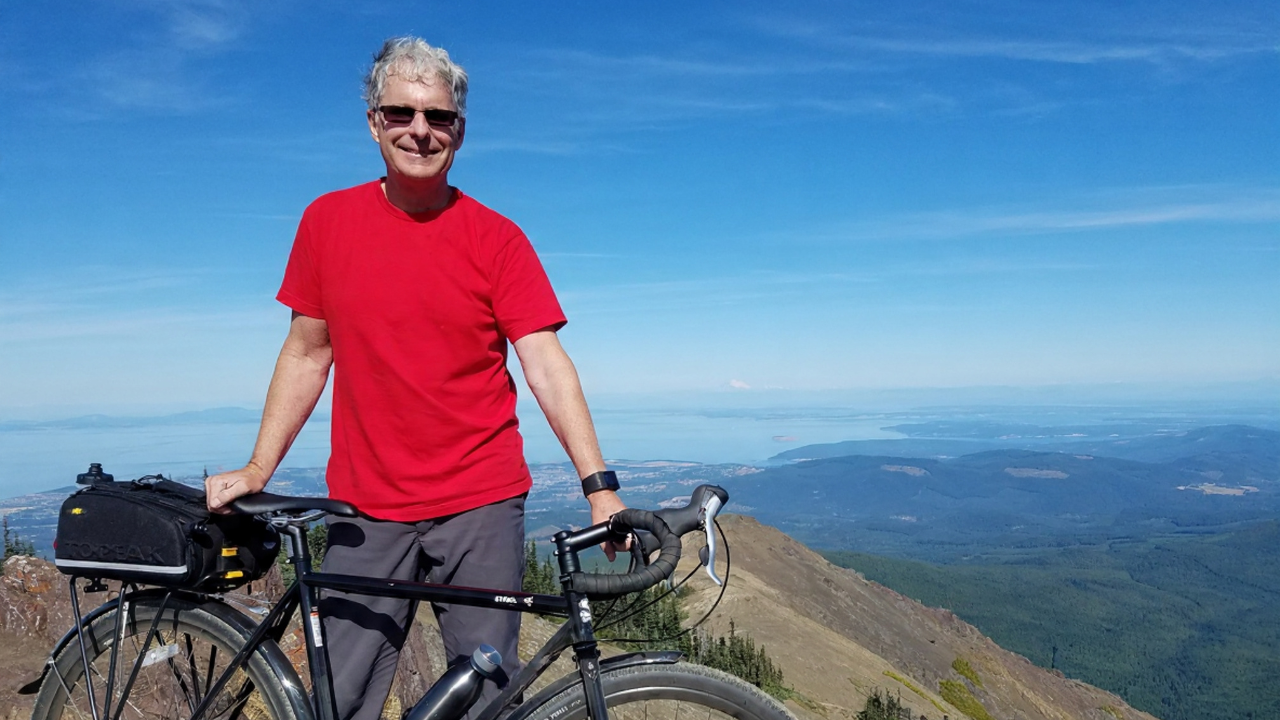
After discovering he carries two copies of ApoE4, Ron Carr spiraled into fear before finding a more grounded path forward.
Ron Carr, who does not have a known family history of Alzheimer’s disease, wasn’t expecting to learn that he carries not only one, but two copies of ApoE4, a genetic risk factor for developing Alzheimer’s. People who carry two copies, like Carr does, have a 60 percent chance of developing Alzheimer’s over their lifetime.
“In a lot of cases, when genetic information is passed along, it goes from parent to their children, but in my case, I found out through my son,” said Carr, 65, who was assistant city manager for Paris, California, overseeing budgeting, public works, and public information departments, before retiring.
More than a decade ago, Carr’s son took a 23&Me test. “He mentioned that he had this genetic variant that might mean he would get Alzheimer’s when he was old,” Carr remembered. “I didn’t think much about it.”
Carr, who splits time between Hemet, California, and Washington State, recently read a book about longevity that mentioned ApoE4. Recalling the conversation with his son years before, he wondered if that was the gene his son mentioned and decided to undergo genetic testing.
“I remember standing at my mailbox and looking at the report that they had sent me, and it gave a risk profile and a spectrum, where I fell,” Carr said, “and I was right at the right end of it, in the deepest, darkest red portion.”
That was 18 months ago. “When I was looking at that,” he said, “I knew that my life had changed at that point.”
Carr’s father had symptoms of cognitive decline starting around age 85, but was never diagnosed, and his mother died at age 90 with no cognitive issues. Carr and his wife were both retired and living an active life at the time that Carr discovered he carries two copies of ApoE4.
Their conversations suddenly shifted to revolve around long-term memory care plans.
Carr began researching ways online he could delay the onset of Alzheimer’s, although many homozygous carriers of ApoE4 do not develop Alzheimer’s in their lifetime. Without consulting a healthcare professional, and starting with very little knowledge on the subject, Carr’s online research led him down rabbit holes of information, some helpful and some not.
“Because I didn’t really know that much, it was kind of like jumping into the deep end of the pool without knowing how to swim,” he said. “I made a lot of mistakes. I switched my diet to something that was supposed to be brain-friendly, that I saw on the internet, and that caused my cholesterol to go up to really concerning levels.”
Carr had followed a specific variation of the ketogenic diet, which is high in saturated fat.
He started spending hours in the gym. “I was working through the pain and the exhaustion, because, supposedly, exercise was clearing plaque from my brain, so I thought it was worth it,” Carr said. “Normally, I love exercise, but it became just an unpleasant chore.”
Carr said he now regrets not consulting with a genetic counselor right away. He thought he could handle it himself, but the emotional toll of the diagnosis was greater than he realized.
“I kind of stopped living in the present at that time,” Carr said. “I was projecting my own future into these stories that I was seeing, and I ended up withdrawing from friendships, and just becoming really disconnected from life.”
Carr read studies that left him perplexed, such as one that suggested that being a homozygous carrier of ApoE4 meant he already had a form of Alzheimer’s. “Intellectually, I knew that these genes were about risk,” he said. “But emotionally, I was feeling that I had gone from being a healthy, happy retiree to somebody who was just waiting for symptoms to start.”
Carr eventually secured an appointment with the team at Keck Center for Personalized Brain Health in Beverly Hills, California, which he describes as the turning point of his story.
The medical professionals at Keck came up with a plan to manage Carr’s cardiovascular health and discovered Carr had moderate hearing loss, which is a modifiable risk factor for dementia, and later encouraged him to get hearing aids.
“I get a lot of reassurance from dealing with a knowledgeable expert on ApoE4 because I feel that they just cover every angle,” Carr said. “They give me a cognitive test every time I talk with them, and so I’m not monitoring the songs that I can remember anymore. I’m basing my progress on data, not the drama that I used to.”
For people that do carry the ApoE4 gene, undergoing genetic testing can allow them to make important financial and care decisions early on. Carr has created those plans alongside his wife and son and established power of attorney.
Carr advises other ApoE4 carriers: “Just play the long game. I made a lot of changes, but they didn’t happen all at once. It takes time. I don’t know what my future holds for me. I know my odds. But I take a lot of comfort in the fact that I’m doing everything that I possibly can to modify my risk. I see myself as a risk manager now, rather than a victim… I don’t see my destiny as Alzheimer’s.”
CORRECTION: 18 May, 2026, 4:00 P.M. – A previous version of this article noted carrying two copies of ApoE4 increases one’s chances of getting Alzheimer’s by 60 percent. It has been updated to reflect that the risk is not 60 percent, rather that people who carry two copies of ApoE4 have a 60 percent chance of developing Alzheimer’s over their lifetime.