Can Organoids Unlock the Secrets of Brain Disease?
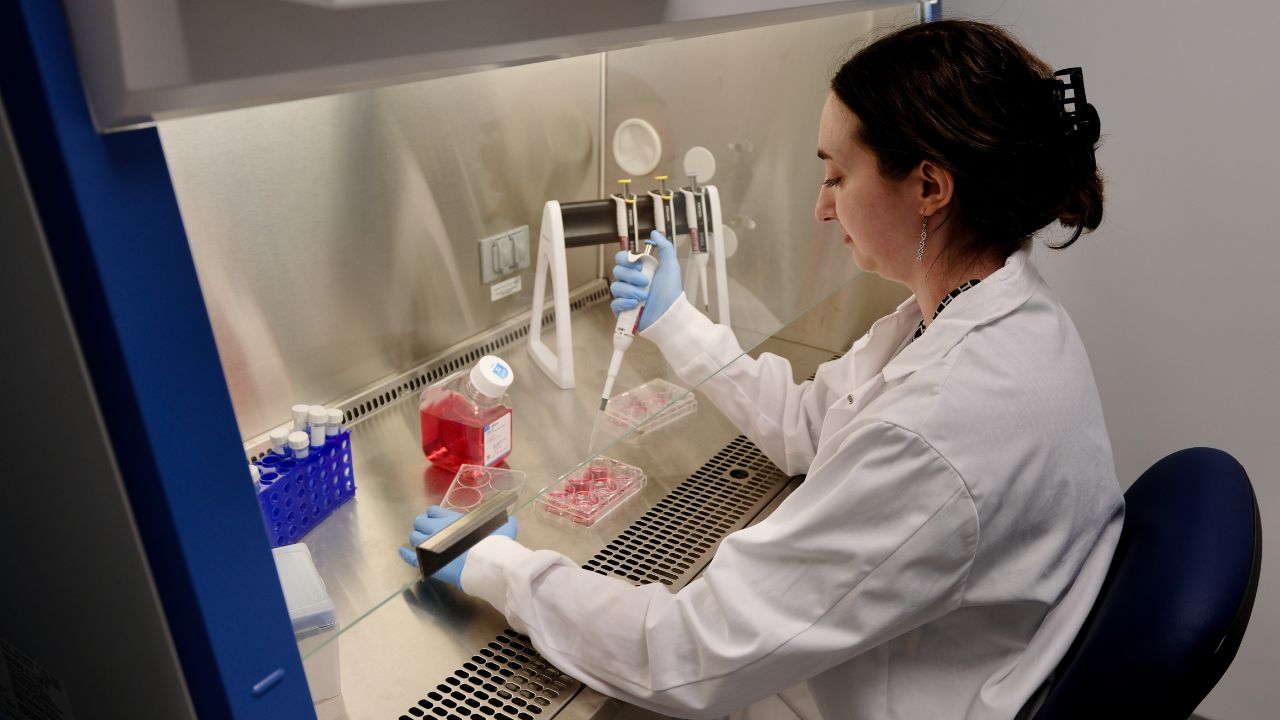
Can “mini brains” someday help find a cure for Alzheimer’s? Maya Gosztyla of BrainStorm Therapeutics is on a quest to find out.
Maya Gosztyla still remembers being 10 years old and seeing the cognitive decline of her grandmother Barbara, who had dementia. Gosztyla has always been amazed that her grandmother had nine children and often finds herself wishing the two had had more time to talk about it.
“She overcame a lot of challenges. But I never really got to hear about any of that firsthand,” said Gosztyla, 29. “I think there’s so many people whose stories just never get to get passed down because their brains got older, and they weren’t able to save those memories.”
Helping people hold onto precious memories is a driving force behind Gosztyla’s work at BrainStorm Therapeutics. Gosztyla is the company’s co-founder and chief science officer. BrainStorm, headquartered in San Diego, does something few companies do: grow brain organoids — artificially grown brain tissue — with the goal of discovering drugs to treat diseases like Alzheimer’s.
The company is using the technology to target rare pediatric brain diseases. She said she hopes to someday develop the ability to age the artificial tissue so that it can also be useful for age-related brain diseases such as dementia in the near future.
Making ‘mini brains’
Gosztyla describes a brain organoid as a tiny, simplified version of a brain, essentially microscopic 3D clusters of brain cells. To make them, scientists take skin or blood samples from a patient and then make them into stem cells that grow to become an organoid in the lab.
“I have a particular protocol that we use to tell that cell to essentially become the brain,” said Gosztyla. “It has all the same types of cells you could find in your brain — it’s just much smaller. It’s about one millimeter in diameter, so maybe the size of, like, a chia seed.”
While brain organoids have primarily been the domain of university labs in the past, Brett Kagan, chief science officer of Cortical Labs, said, “The progress from out of the university and into industry is incredibly promising to improve the reproducibility and scale of these systems and realize the potential this technology has to offer.”
Kagan, whose company grows neurons in silicon chips, acknowledges that it’s still early days for the technology,
”Neural organoids seek to model perhaps the most complex known structure, the human brain,” he said. “While these organoids are far simpler than brains and still have some technical barriers to overcome, they can offer a compelling insight into how neural systems operate.”
Brain organoid technology has been around for more than a decade. In 2013, a group led by American biologist Madeline Lancaster published the first protocol for generating more complex 3D cerebral organoids from stem cells. Gosztyla says BrainStorm’s work is building on the shoulders of giants by overcoming the problem of producing organoids that come out different each time.
“I want to have a thousand identical brain organoids so that I can see what the effect of the drug has on them,” said Gosztyla. “Nowadays, we have a kind of unique, newer version of the protocol that’s taking many, many years of work to develop that now allows us to actually get these very homogenous and identical brain organoids that we can grow in super high throughput, thousands and thousands of them that all look pretty much the same.”
Gosztyla says it takes a couple of months to grow the stem cells, and then another two to six months to grow them into a brain organoid. But her team can grow a few thousand organoids at the same time, allowing them to test five to 10 thousand drugs on them a day.
Human vs. animal brains
Gosztyla also believes it will someday prove more effective for Alzheimer’s drug testing compared to using mice, as mice don’t naturally get Alzheimer’s-like brain changes.
“The problem that’s arisen is that the thing that we induce in mice turns out to not actually be that close to human Alzheimer’s,” said Gosztyla. “We must have cured Alzheimer’s like over a thousand times in mice and not a single drug has actually cured Alzheimer’s in humans once it gets into the clinic.”
Some animals do get dementia, including dogs, cats, and even dolphins. But nothing is as direct as studying the way disease pathology moves through the human brain itself. Beyond the ethics of animal testing, Gosztyla says, “Animals just aren’t very good at simulating our diseases and also predicting what drugs will reverse those diseases.”
In addition to drug testing, the BrainStorm team is using their platform for drug discovery with the help of AI models. Gostztyla believes AI has yet to revolutionize drug discovery because even though AI models are designed to optimize chemistry, they’re often built off of a fundamentally flawed understanding of biology.
“It’s a ‘garbage in, garbage out’ scenario,” she explains. “If you feed your AI model data from mouse models, for example, we know that those don’t actually predict human success.”
Organoids, on the other hand, are a “biology-first” approach to drug discovery: “We take all of the rich data that we get from our organoid studies, and we can feed that into our AI models and use that to predict what are the best targets to go after for drug discovery before we even worry about the chemistry.”
“Mini-brains” for neurodegenerative diseases?
BrainStorm is currently working with two companies to develop a brain organoid model that quantifies how known Alzheimer’s biomarker tau protein spreads between neurons.
One major challenge with organoids? These mini-brains are suspended in time: They cannot simulate aging.
“Even if you take a sample from an adult, it’s still going to look like a fetal version of their brain,” Gosztyla said. “And so that limits the kind of how applicable all these models are to things like Alzheimer’s and Parkinson’s.”
The goal is to work towards inducing aging in the organoids, she said, so that they can study more than just the very early signs of Alzheimer’s. Gosztyla said she wants to be able to use the technology to mimic the brains of older adults too. “Can we then actually reverse some of those changes in a model that looks more like the brain that a 65-year-old or a 75-year-old might actually have?” she asked.
Treating rare youth brain diseases
BrainStorm is currently focused on the area of rare pediatric brain disease. According to Gosztyla, their technology found that the Alzheimer’s drug donepezil reversed seizures in organoids, and they’ve received FDA approval to move into Phase 2 clinical trials to repurpose the drug for patients with Rett syndrome, a neurological disorder that typically affects young girls.
The hope is that after finding success developing drugs for rare pediatric brain diseases, that will allow them to ramp up testing for more common disease programs involving Parkinson’s and Alzheimer’s.
With her grandmother in mind, Gosztyla says it’s important for scientists in the lab to remember the people living with neurodegeneration, and do all that’s possible to shorten the timeline to effective treatments.