Inside ‘Memory Generation,’ an Interactive Theater Work About Living With Dementia
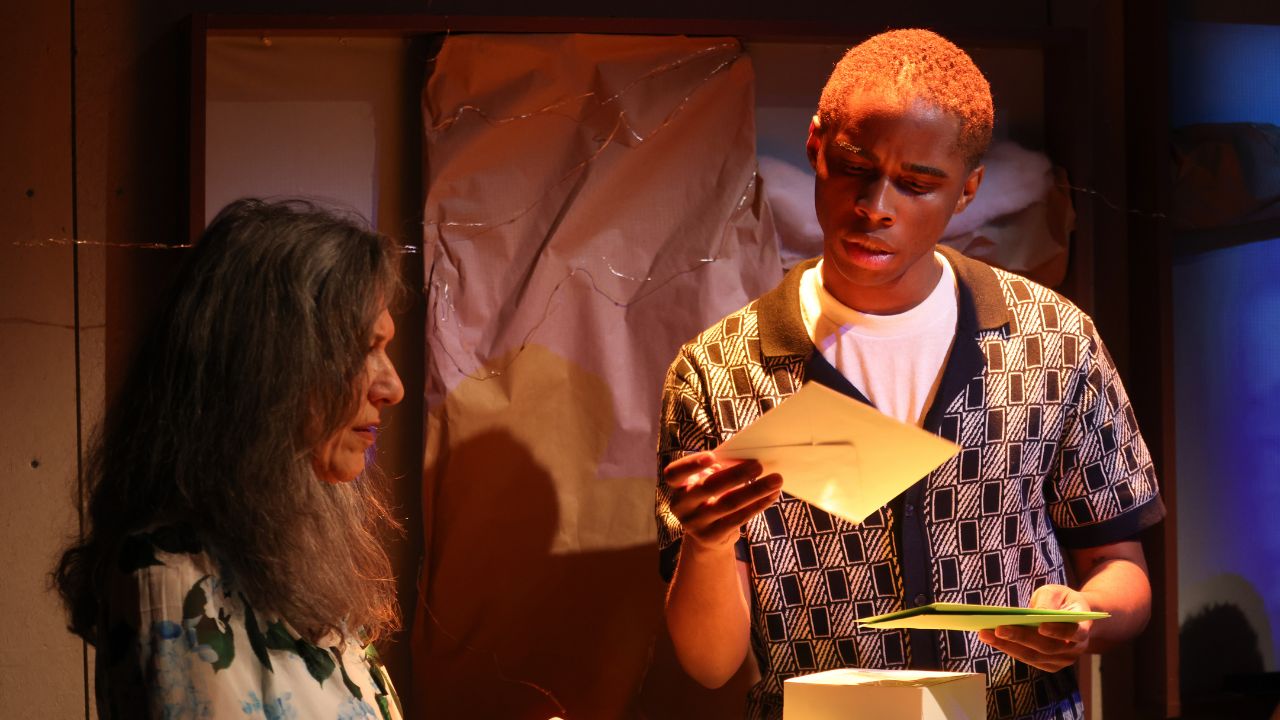
Artists Sara Zatz and Sherrine Azab discuss ‘Memory Generation,’ an interview-based theater work set in a memory cafe that explores dementia, caregiving, and community.
The experience of dementia, for people living with memory loss and for the family members and friends who care for them, is often told through the language of loss. But there is a growing effort to change that, creating work that centers connection, humanity, and what remains.
One of those projects is “Memory Generation,” an interview-based theater production set in a memory cafe, where people affected by dementia gather in a space built around creativity and community.
Memory Generation was created by Sara Zatz and Sherrine Azab and premiered this year at La MaMa in New York City. Zatz is the artistic director of engagement at Pink Fang, where she develops community-based work rooted in first-hand interviews. Azab is a Detroit-based theater director and co-director of the ensemble A Host of People. Both drew on their own experiences as family caregivers for loved ones living with dementia, as well as interviews with people across the country and the lived experiences of the show’s performers.
In this Live Talk with Being Patient’s Mark Niu, Zatz and Azab discussed how they built the production, why they set it inside a memory cafe, and how they worked to portray caregiving without reducing it to its hardest moments. They also reflected on questions of consent and whose stories get told, the strain that limited resources place on caregivers, and how the arts and community might help build what they describe as a more dementia-friendly society.
Being Patient: Tell us about “Memory Generation.” What exactly is it?
Sara Zatz: It is an interview-based theater production set in a memory cafe. The impulse was to create a performance for, by, and about people with memory loss and the community members and family members who are living alongside people with memory loss — to express the everyday realities of those experiences, and to do it in a setting that models a memory cafe environment, which is a contemporary approach to caregiving and enriched life experiences for people with dementia and memory loss.
The project, which we’ll get into more details about, is based on first-hand interviews with people across the country. It’s also rooted in the experiences of our performers, who had their own direct experiences with memory loss, and it draws on my own personal experiences and Sherrine’s personal experiences as family members of people with dementia.
Being Patient: Sherrine, your thoughts on how this all got started?
Sherrine Azab: Sara knew that we both shared this experience of being caregivers. When she was thinking about how to make a piece about it — we had collaborated in the past — Sara reached out to me and said, “Would you want to collaborate on this?” And it felt really meaningful and personal. It’s a piece and a topic that really affects a lot of people. And that’s really where my heart is around art making. To do it with Sara, who I know I have a lot in common with as theater makers but also have this shared experience with, felt like a really natural and beautiful alignment.
Being Patient: So far, where has it been shown?
Azab: So far, it’s only been shown in New York at La MaMa. But we have plans to bring it to Detroit in 2027 or early 2028, after my theater company opens an arts space here in Detroit. It will be one of the first productions we present in our new space.
Being Patient: Does the audience participate in the performance?
Azab: As we mentioned, we took inspiration from the idea of a memory cafe — these really unique and beautiful spaces that are both dementia-friendly and where you can leave your diagnosis at the door and just participate in a communal activity together, as a caregiver or as a person living with memory loss.
They’re not all literally cafes, but we took the inspiration of a cafe to put our audience at cafe tables and have the action of the play happen all around them and amongst them, weaving all through the audience.
Part of that is really about creating community within this performance. Even though we were specifically centering people living with memory loss and their caregivers, the experience of dementia is, unfortunately, something that’s going to touch almost everybody — whether it’s somebody you love and are in direct relationship with, or somebody you know who is going through this experience. Everybody is going to be touched by this in some way. So we really wanted to create an environment where everybody was involved and everybody could feel connected, and where, if they’re not affected by this diagnosis right now, they could feel more connected and more prepared if it does enter their life.
There’s that whole community aspect happening, but also some very light participation, where we asked the audience the questions we’re grappling with: What does it feel like to receive care? Or what do you think of when you hear the term caregiver or caregiving? Those were some really central questions we were asking in the production.
Being Patient: I want you to talk about the inspiration that comes from your own experiences — tell me about those experiences and how they’re incorporated into this work. In some ways it’s a very difficult thing, and people might think the material is too heavy. So talk about the challenge of telling your stories, and also making it palatable or entertaining for audiences.
Zatz: The original impulse to create Memory Generation really came out of my experience with my dad and his journey with dementia, and his relationship with his partner, who was living with a physical chronic illness alongside my dad, who had cognitive decline. So they were kind of in a mutual caregiving relationship. They were familiar with the work of Ping Chong and Company, which is the previous incarnation of Pink Fang — now known as Pink Fang — and the interview-based work we do with community members.
My dad’s partner, as she was grappling with her changing role and relationship with my dad in the caregiving environment, turned to me one day and said, “This is really hard. You should make a show about this. People really don’t understand what it’s like to be doing this caregiving.”
It’s particularly around that changing relationship, as people have an expectation of a marriage, a sibling or a parent-child relationship, or even a friend or co-worker relationship. So that was the ask that was gifted to me. It was actually shortly before my dad’s partner passed away, and my dad moved into memory care at the same time. So those were some personal contexts for me to really want to tell the story of caregiving and care receiving through the lens of dementia.
Having a lot of Alzheimer’s and dementia in my family, I was really seeing how it shows up so differently for every person, every person with memory loss, and every caregiving relationship. As I started on that journey, I knew that Sherrine was also going on this journey, maybe a couple of years behind me.
A lot of this really came out of two artists and friends and collaborators having conversations about, “How are you doing with your family member?” And when I had that urge to honor this request from my dad’s partner to make a show about it, Sherrine was the first person I thought of, as someone who was both living it and — as Sherrine said — very aligned in our theater-making practices. That’s where we started from.
For me personally, a lot of my own story and a lot of my dad’s story is in the final show, including audio recordings of conversations I had with my dad in the final year of his life. My dad actually passed away in the middle of the process of creating the show. I was working on the script with Sherrine, and it was January, and we knew we were presenting it in May. So it very much informed the creative process — specifically that question of how do we bring forward the direct voices of people with memory loss while ethically thinking about who is performing, who is telling their stories, what consent means, and permission to share stories.
I was able to have a conversation with my dad about permission to use the stories, which I felt was ethically sound, to include in the show. For other people, we didn’t use their real voices, but we adapted interview questions from people.
Typically, the work I’ve done in interview-based theater has included the actual person telling their own story on stage. In this case, we had a mix of composited stories drawn from interviews and direct personal experiences shared through the actors.
Azab: It’s a little bit different for me, because my caregiving journey has been pretty fraught with some tension within family dynamics and family relationships — decisions about the caregiving for a family member. I’ll just say that I’m using the terms “family member” or “loved one” very specifically, because the person I’m in a caregiving or care partnership with still has a lot of complicated feelings about their diagnosis.
As long as they can, I want to honor that they’re not wanting to be public about it while they can still make those choices. It was interesting for me, entering this knowing that I have some real conflict with family members about the caregiving journey we’re on, and also that my family members feel it’s very private. But it was great, because I was still able to share a lot of my experience and make it into the show.
A lot of times we actually changed the relationships for everybody, so that we could show how these different dynamics could be. We did want to have represented in the piece that there are a lot of different types of challenges in a caregiving journey. Some of them are just the day-to-day of a really hard diagnosis, and some have to do with the interpersonal relationships you have when maybe you’re not in alignment, or maybe the person isn’t a loved one that you’re now in a position of caregiver for.
We also wanted to capture some of that stickiness and tension, to have a pretty broad range of representation of what these journeys can look like.
Zatz: You mentioned that question of humor — how to make it, frankly, not depressing. That was a very early conversation we had as well, acknowledging that there’s a lot of information, material, and pop-culture media around how hard and terrible caregiving can be, all the good, bad, and ugly of it.
We really wanted to talk about what it means to hold and create a space of care, where people talked so much in the interviews about, “I wish I had accepted help,” or “I wish I had asked for help.”
Creating a space where that idea of help, and showing up together as a community or a society, is visible and present leads to this question of humor, or tenderness, or relationships that may be different. There’s grief in that, but they can at times become richer and more beautiful. That’s not everyone’s experience, but we really wanted to hold on to this idea that it doesn’t have to be the worst-case scenario in terms of how these relationships are held during this truly difficult journey.
Being Patient: It’s interesting that most of the actors had experience with caregiving in their own lives and families. Did you feel it was important that they had that element? Or does it come out that they put on a better performance because they have that experience?
Azab: It was really important to us that the folks holding the space and performing in the show did have a relationship to caregiving and care receiving, because we wanted the piece to feel really honest. If some people feel like they’re putting it on and acting it, it’s going to change the dynamic in the room.
Before we even started rehearsals or scripting, we had some meetups with other artists we knew were caregivers, just to talk about our experiences of having that dual identity of being artists and caregivers. Through that, we identified that we wanted to make sure the people performing in the show had that experience as well.
We reached out to folks we knew had that experience, and then had conversations and interviews with them to see, number one, if they felt emotionally ready, if this was something they were interested in, and if they understood the process and what they were going to be holding.
Almost all of the performers had some sort of relationship not just to performing, but also to community engagement and facilitating — because the show itself, like I said, has a lot to hold in it. You want to be able to ask these questions of the audience and hold their responses, whatever they may be.
It was more important to us that they had this experience, that they could hold the audience and these questions in a container of care. It was a really great bonus that they’re all beautiful performers, but that was our secondary thinking. It needed to be there too, but in partnership with the other elements they were bringing to the project.
“[W]e really wanted to hold on to this idea that it doesn’t have to be the worst-case scenario in terms of how these relationships are held during this truly difficult journey.”
Being Patient: Let’s talk about some of the themes and issues explored in your work. I’ll bring up one: the whole issue of long-term care and access to resources, which is also a big part of your play. Tell me about that.
Zatz: It’s on my mind right now as I’m approaching turning 50, thinking about my future. Something like long-term care insurance was just something that some of our parents had access to, and a lot of people in my generation don’t have that anymore — even that basic opportunity to invest in it, if you have the means to do so, isn’t as available now.
I mentioned my dad, who happened to be a scientist and a federal worker, and had a pension that supported some of his end-of-life care. Other people don’t have that luxury. What does it mean when you’re making choices about whether you bring a parent to live in the home with you? Are you changing your own living situation to live with a parent? Or people who give up paid work in order to be a full-time caregiver? Again, these things came up in a lot of our conversations, both with our cast members and in our own lives.
I think this intergenerational care is really important in terms of social care and long-term care. We spoke with several people who were primary caregivers for grandparents, and that’s not something we talk about that much in our daily conversations about long-term care.
Azab: I’ll just add that the topic of resources, in regard to dementia and any really intense diagnosis, is really challenging in this country, and really frustrating. There’s even the resources around money you don’t think about, around time and support and who can show up.
What we wanted to offer in our one-hour show, where we were trying to make an experience to start conversations, was also: when resources aren’t there, how are we showing up for each other? Because there are always going to be challenges with resources, both monetarily and in time. How can we expand our thinking around resources as a community, to see how we can support each other more?
Zatz: I’ll just add that this is something artists are really good at thinking about, because artists have historically lived with limited resources. The audience wasn’t specifically made up only of artists, but when we’re talking about gig workers, people who don’t have health insurance through a typical nine-to-five full-time job, people who are maybe in non-traditional family structures — artists have spent a lot of time in solidarity work in communities, thinking about how to care for each other.
There’s a lot of inspiration to come from that mutual aid, and from communities that have had to take that care into their own hands because the systems are not willing or able to provide it. So the big question underlying a lot of that one-hour show is: what does it mean to live in a dementia-friendly society? What does it mean to live in a place where we can build toward maybe less singular relationships around caregiving, and more collective community care?
I’ll also throw in the difference between urban and rural or suburban caregiving, which is also extraordinarily different. I’m here in New York City; I know loved ones in Sherrine’s life are living in less densely populated areas. Getting to and from doctor’s appointments, whether you have a car or not — just basic things around transportation bring up so many issues.
“We wanted the piece to feel really honest.”
Being Patient: What’s next for “Memory Generation”? And if you take it to other places, will we see new actors interviewed in the region?
Azab: I’ll talk about what we know is going to happen — the Detroit version. We’re still in a sort of dreaming stage about what it means to bring it from New York to Detroit. We’ll definitely have some Detroit actors in the production. We’re still thinking about whether we want to bring a couple of the New York actors, or do an entirely Detroit cast, but either way, the new actors will be interviewed, and some of their stories will be newly woven into the script. The bones and the skeleton of the script will be the same, but we’ll weave in some new experiences of the folks participating this time around, which I think is really exciting.
If this has a life beyond that, we can continue to bring more and more experiences into the piece, which I think is a really beautiful continuation of this project. There’s a lot of momentum in Detroit, too, around arts organizations starting memory cafes and doing this type of work. So I’m really excited to be able to bring this work and these stories to my community here as well.
Zatz: I think this conversation around how artists are engaging with stories of dementia — both telling stories about, and telling stories with — feels really important to me. One of the things that has come out of this work is a really beautiful network of artists in the United States, and also some international artists, who are doing this work. I would really love to continue building on that network, and amplifying and supporting other projects happening around artists and dementia, and thinking about how all of this intersects with a larger movement toward arts and health.
The conversations we’re having in terms of public health, social prescribing — the idea that one way you can combat potential dementia is through community building, preventing isolation, finding those places to feel a sense of belonging — I feel like that’s what artists do best. So if there are ways for us to take the tools and practices we learned through the creation of Memory Generation and apply them both to other public health issues, or other ways of interacting with this complex layer of personal and public health and institutional medicine, I think there are a lot of opportunities to keep expanding how those stories get told.